Every once in a while a gentle reader shoots me a comment or an email about my use of the term time blindness. I once saw my work reshared with a content warning re: my use of the term. They explained time blindness was a more commonplace and accepted descriptor for ADHDers’ time perception impairments when I published my article (roughly two years prior).
Some folks in the ADHD and disability advocacy communities have come to see time blindness as ableist language. Many consider it harmful to use the word “blind” to describe anything other than visual impairment.
I agree in many cases. As Lydia X.Z. Brown explains in a very handy post on Autistic Hoya, “blind” is often used as a metaphor to describe people who are willfully ignorant, overcome by prejudice, or deliberating ignoring a crucial point. This reminds me of terms describing intellectual disabilities which have been co-opted as insults. Not great.
But something about time blindness as an ableist term never sat right with me. Today I’m finally sitting down to articulate why.
For starters: where does the term time blindness come from?
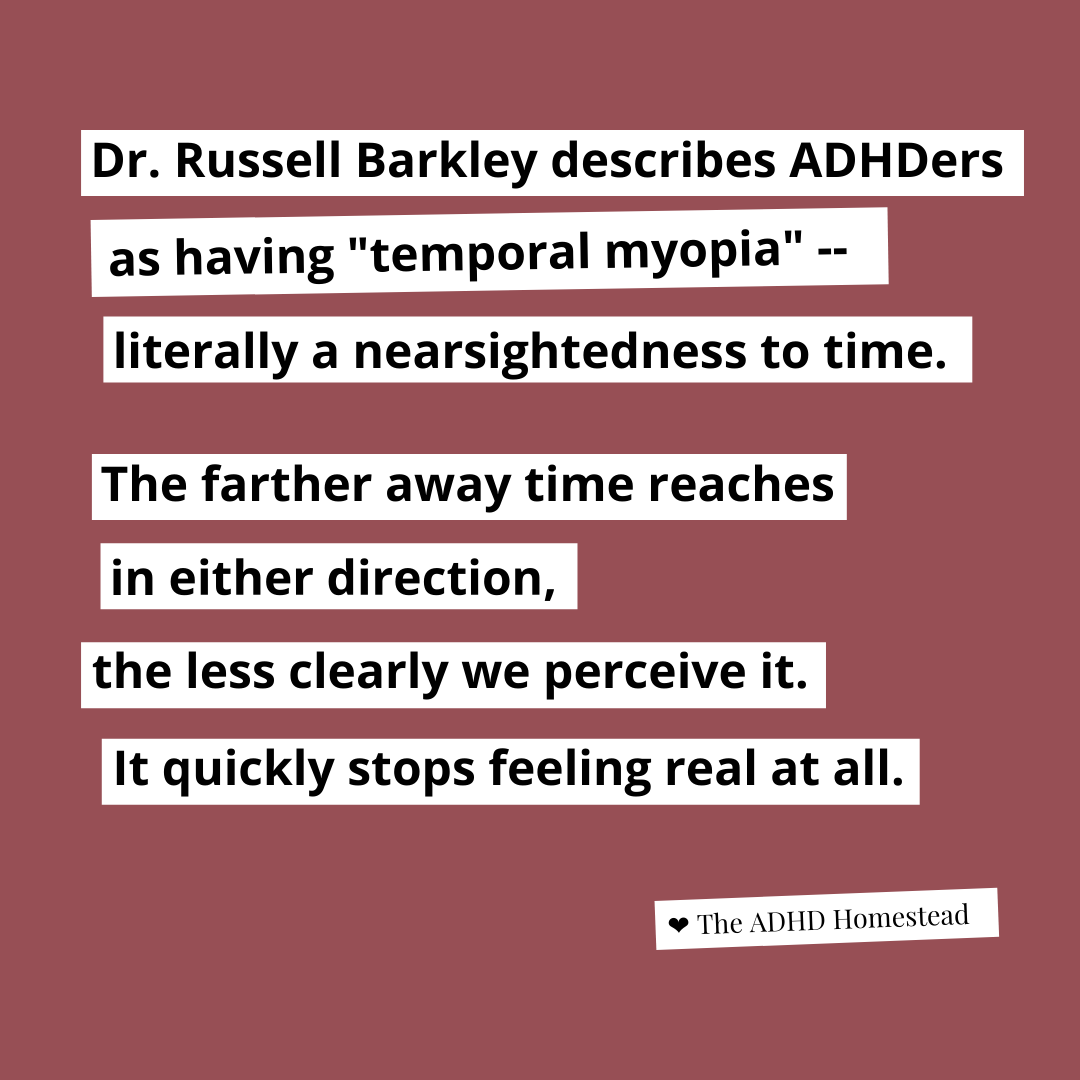
ADHD researcher Dr. Russell Barkley appears to have coined the term time blindness in a 1997 paper about self-regulation and time perception in people with ADHD1. He has also called this phenomenon temporal myopia. In other words, literal near-sightedness to time. He explained the concept well in a talk for the 2009 CADDAC conference, titled ADHD is Time Blindness.
Since then, the professional community has adopted time blindness to describe ADHDers’ time perception challenges.
Then the COVID-19 pandemic obliterated the general population’s time-perception footholds. A surprising number of mainstream media outlets ran articles with time blindness in the headline. I still don’t know how I feel about this. In some ways, it’s great to increase awareness. In others, much of the conversation lands similar to the perennial favorite, “we’re all a little ADHD sometimes.” The pandemic may have created acute symptoms for many people, but that doesn’t mean they understand what it means to live our whole lives this way.
This makes time blindness, much like ADHD itself, a bit of a gray area. The term can be misused and overused by the general population. This behavior ventures into ableist territory similar to language like “I’m feeling so bipolar lately” or “he’s schizo.” But context matters. Bipolar isn’t a derogatory term, it’s a diagnosis. Only when we use these terms colloquially, as (often negative) metaphors, do they become harmful.
What’s the intent of the time blindness metaphor?
Barkley’s original use of “blindness” to refer to time perception was a metaphor in a certain sense, but hardly a derogatory one. He has consistently used the term to help educate the public about how we experience time. This language combats ignorance and stigma around ADHD behaviors.
As I point out in my popular post on ADHD time perception, it’s a particularly harmful aspect of adult ADHD. Time is so much more than productivity and Western cultural norms. It undergirds our ability to maintain healthy relationships and regulate our emotions.
Describing these perceptual challenges as time blindness helps drive home an important point about intent. Rather than irresponsibility and lack of consideration for others, our self-regulation challenges stem from a fundamental inability to perceive time accurately. As Barkley puts it, temporal myopia prevents clear perception of time outside the present.
How I use visual impairment analogies in my writing.
Since I published it in 2018, my post How it really feels to be time-blind with ADHD has consistently remained my most popular. In it I draw an analogy between time blindness and color blindness.
An excerpt:
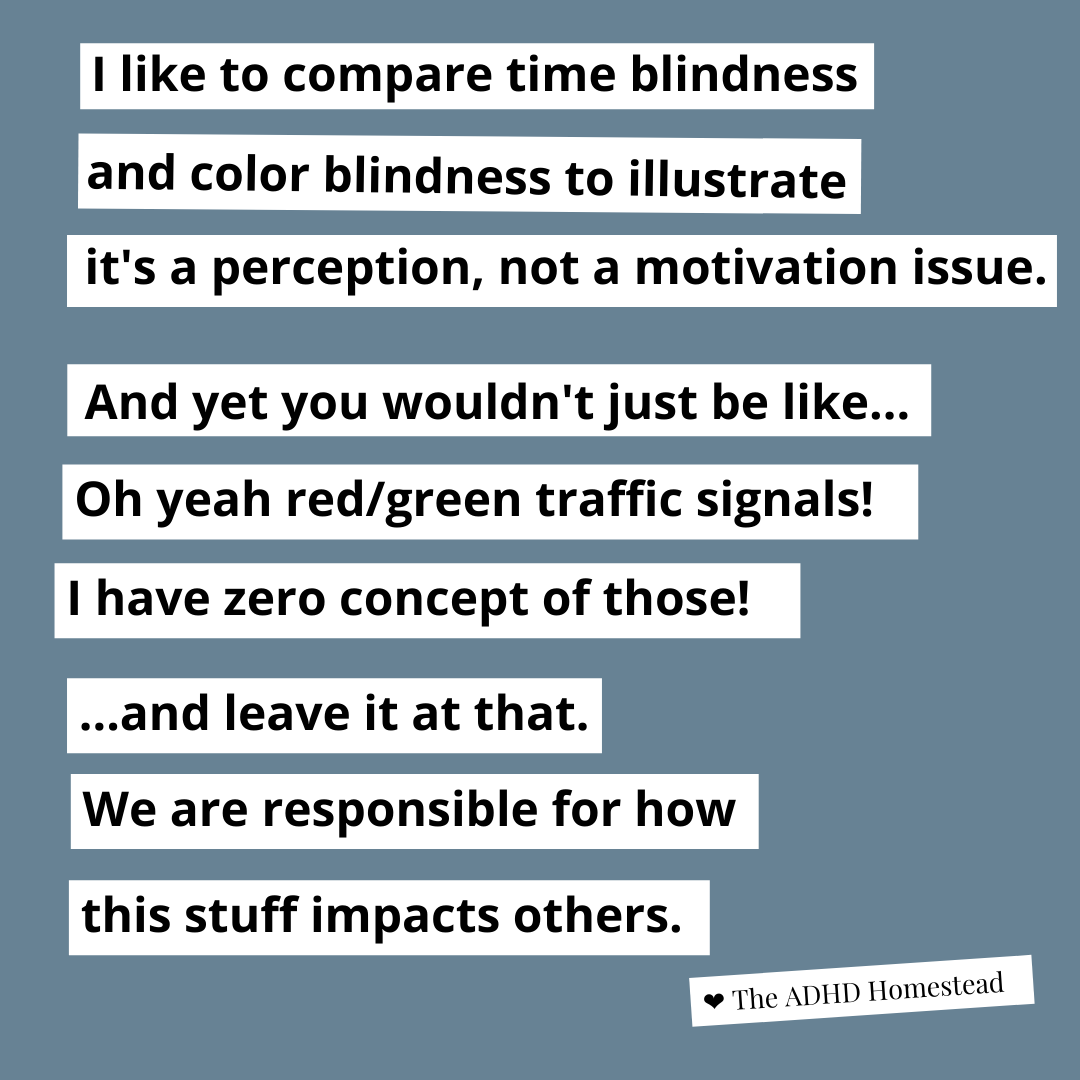
It’s one thing to know a fact in your brain: this flower garden is full of rich, beautiful shades of red and green. I need to make sure I’m on time for this meeting. It’s quite another to experience it, at a sensory level…You wouldn’t assume a colorblind person simply doesn’t care enough about distinguishing red from green. Neither should you assume a person with ADHD doesn’t care enough to manage time properly.
How it really feels to be time-blind with ADHD, April 11, 2018
The popularity of this post — in March 2021, the eve of its third birthday, nearly forty-five thousand readers found their way to it — tells me it strikes a chord. The comments reflect a wide range of reactions, from extreme gratitude to cantankerous skepticism. I’ve revised a few times over the years, partly in response to the latter. I want to be crystal clear: I may give tough talk to my fellow ADHDers sometimes, but I support them. I get it. My writing isn’t for everyone and I want it to challenge the reader occasionally. At the same time, I don’t want my tone or content to feel outright hurtful.
I’ve stood by my color blindness analogy. It’s the best way I’ve found to undermine ADHD stigma and illustrate the innateness of our limited time perception. Others have made similar comparisons between ADHD medication and medication for less-controversial medical conditions like diabetes or atrial fibrillation. When an aspect of our physiology interferes with our quality of life — even threatens to shorten our lifespan — and a daily medication regimen exists to counter these negative effects, there’s no shame in taking it. These are not things we control, and they don’t reflect our character or commitment.
I also — and here’s the tough talk — appreciate the responsibility implied by the color blindness analogy, as articulated here:
Colorblindness doesn’t give anyone license to ignore traffic signals. It also doesn’t make it okay to demand someone sit in the passenger seat and call out the color of the signal for every ride. Likewise, we ADHDers aren’t doomed to go through life hurting people and letting them down every day, nor should we put the burden of responsibility for our time blindness on others.
How it really feels to be time-blind with ADHD, April 11, 2018
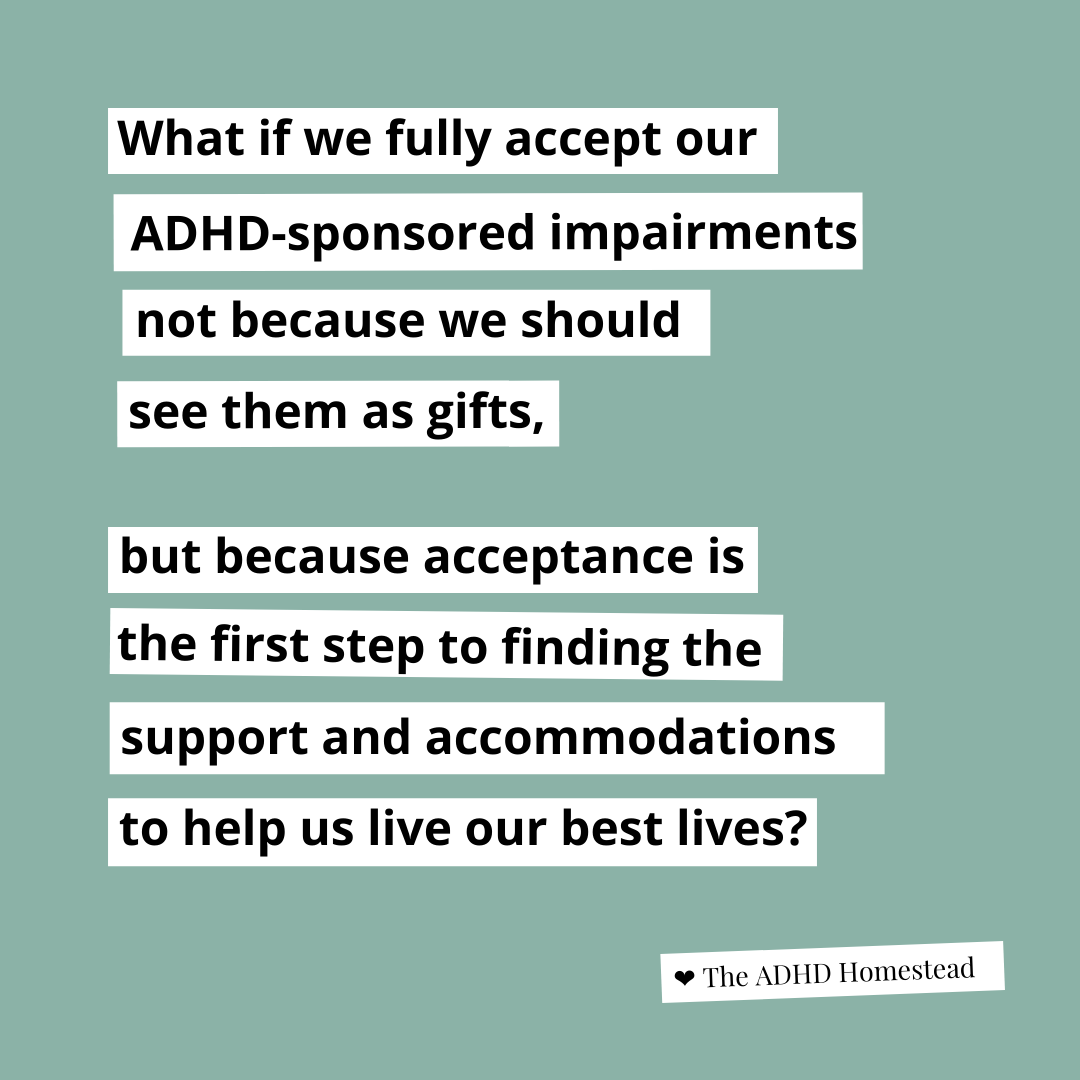
While we don’t choose our perceptual impairments, we are still responsible for them. I don’t say this to dismiss ADHDers’ (or color blind folks’) struggles. Rather, I offer both hope and accountability: we can learn to live and work with our perceptual impairments. Accepting them fully allows us to find accommodations and live fuller lives.
What does it mean to suggest ableism in time blindness?
Returning to Autistic Hoya’s massive list of ableist language, what are the implications of claiming “blindness” has been used in an ableist way here? Brown provides the following suggested alternatives: “willfully ignorant, deliberately ignoring, turning their back on, overcome by prejudice, doubly anonymous [in the case of research studies], had every reason to know, feigned ignorance.”
Every single suggestion in that list sends a clear message about intent: this person could’ve done differently. Instead, they chose to remain ignorant. They closed themselves off to other perspectives. Even in the relatively innocuous example of “double-blind” studies, the terminology reflects choice and intention.
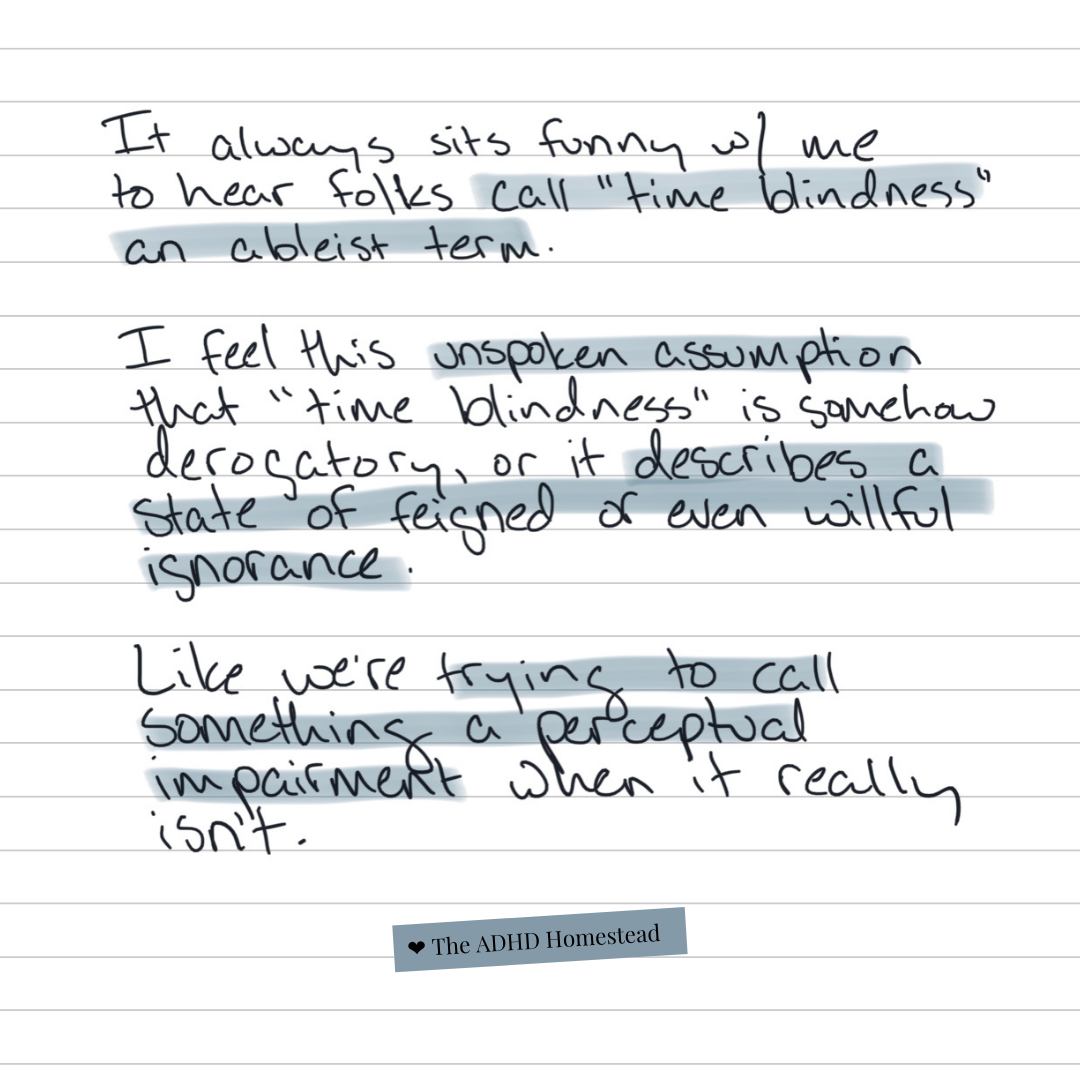
When we talk about time blindness, we are not being flip. We are not being derogatory. We are not describing people who “turn a blind eye to” the clock or “had every reason to know” they did not have time for one more thing before leaving to pick the kids up from school. Rather, we’re saying, we understand the words you use to describe this in theory, but in practice, we can’t perceive it the way you’re describing.
The difference is striking.
I’m left to wonder: what aspect of the term time blindness do people consider ableist? And does this reflect a lingering assumption or bias? A suspicion that maybe this so-called blindness to time isn’t quite as baked-in as we claim, and what we call impairment may be hidden ignorance after all.
Footnotes
1: Barkley, R. A. (1997). Attention-deficit/hyperactivity disorder, self-regulation, and time: toward a more comprehensive theory. Journal of developmental and behavioral pediatrics.
Hey there! Are you enjoying The ADHD Homestead?
Here's the thing: I don't like ads. I don't want to sell your attention to an advertising service run by the world's biggest data mining company. I also value my integrity and my readers' trust above all, which means I accept very few sponsorships/partnerships.
So I'm asking for your support directly. For the cost of one cup of coffee, you can help keep this site unbiased and ad-free.
Below you will find two buttons. The first lets you join our crew of Patreon pals and pledge monthly support for my work. Patrons also have access to my Audioblogs podcast. The second takes you to a simple donation page to pledge one-time or recurring support for The ADHD Homestead, no frills, no strings. Do whichever feels best for you!

Thank you for taking the time to articulate your views on this, Jaclyn. It’s clear that you’ve taken the time to consider a lot of nuance. Your point (paraphrasing), “when someone says the term ‘time-blindness’ is ableist, they’re suggesting it’s not real” is an interesting one and makes me wonder if this is true of all ableist terms. I struggle to think of a counter-example. Maybe it’s also an issue of coopting the term “blindness?” It’s hard to think of a good example, but I wonder how I would feel if someone referred to another condition as “ADHD but for ____.” I guess, to your point, it would really depend on the context and how the writer is trying to use the term “ADHD.”
Also just want to say that I appreciate how you often talk about responsibility in your posts. I don’t think it’s too harsh at all and I think the reason is that you always talk about responsibility as a consequence of acceptance. If you accept your reality fully, you can take responsibility for the way your reality manifests in the world. To use a common ADHD cliche, I accept that my vision is terrible and know never to get behind the wheel of a car without my glasses. I’m not a bad person for having poor vision, but I would be if I ignored it and drove a two-ton piece of machinery without being able to see. Similarly, my poor perception of time doesn’t make me a bad person, but expecting my partner to handle all of my appointments would make me a crappy partner. Instead, we talk together about my reality and find ways to work together.
Yes, context matters so much! Most of us grew up using a slew of ableist derogatory terms. Intellectual disabilities in particular were such a popular punch line. I cringe to think about it now and hope things have improved even in the community where I grew up. It’s hard to know because my own kid is growing up in a totally different place.
I’m glad to hear you say that about responsibility. That’s exactly my feeling on it. It took work for me to get there. Many of us develop a very defensive posture — mostly out of necessity early on. Any mention of our foibles can feel like a deep personal criticism. However, full acceptance of those foibles has been key to bringing more peace to my life. If we don’t accept it, we can’t learn how to work with it. And like you said, we will also continue to allow its affects to impact others unfairly.
Thank you for such an insightful, thoughtful, logical analysis of the issue. I hope you don’t get too much crap for it 🙂
Glad it resonated with you! And even if I do…it won’t be the first time. LOL. I don’t mind getting crap for stuff at all, actually, as long as the response reflects an accurate understanding of what I said. Sometimes a lot to wish for on the open seas of the internet, but I try to keep the hope alive over here!
We also use the term “face blindness” as common parlance for prosopagnosia. A person with face blindness can see, but is unable to easily (or at all) identify, recognize, and distinguish people’s faces. This is more directly related to vision and visual processing disabilities but it is not ocular or neurological blindness itself. As someone who is faceblind and very ADD, I wouldn’t say that time blindness is an inherently ableist term but I would gently suggest using a different way of discussing it. I’ve seen many people use the term “time agnosia” instead – which still captures the meaning of not being able to understand or reliable use time. It has the same root as prosopagnosia as well as in spatial agnosia (also common in many ADD and autistic people), and doesn’t rely on using another type of disability as a vehicle for describing a different one. I personally wouldn’t use the term “time blindness” for the same reason I wouldn’t describe my mental health disabilities as “mentally paralyzing.” Paralysis and paralyzing are not slurs, and though while many people experience psychosocial disabilities in distressing ways that can result in freezing up or shutting down, it strikes me as inappropriate and unnecessary to use the term paralysis when we have plenty of other equally effective ways to describe the effects and characteristics of psych disabilities. It’s not that I think one can never use disability related language or ideas in ways not directly tied to the original concept, but that doing so can nonetheless function as an unnecessary co-optation. I hope that makes sense!
Thank you so much for taking the time to write this reply!
And it does make sense. This argument — that we shouldn’t co-opt terminology from one disability to describe another when alternatives exist — actually makes the most sense to me, and has inspired me to shift the language I use in my own writing here over the past several months or so.
Another commenter made a comparison to saying “it’s like ADHD but for ____” to describe another phenomenon. How would this sit with us? Context would matter a lot for me. However, even if it described something accurately — say, if “hypothyroid ADHD” was a thing — I might still find it a little itchy. It’s tough to say. But I can see how applying a term more broadly than originally intended, even with the intent behind “time blindness,” could feel diminishing. Kind of like when one shares a painful experience with a friend and the friend replies “oh I know *exactly* how you feel, the same thing happened to me.”
I wanted to start talking about who gets to choose and change “industry standard” language in these spaces but this post would’ve been way too long. Plus that may be its own essay for another time, maybe on my personal blog instead of this one.
I intended this post as a conversation more than a doubling down. Over the several months I’ve started to shift the way I use the term “time blindness” in my posts here. I will more often offer it as a parenthetical — e.g. ADHD’s time perception impairments (sometimes referred to as “time blindness”) — rather than a first-choice descriptor. I want to look into agnosia, as I’d want a full understanding before adopting use of a more precise-sounding term. Regardless, I’ve made a deliberate attempt to stop leaning on time blindness exclusively and use other words instead.
On the flip side, a lot of people find and benefit from my work by typing “adhd time blindness” into Google. And the analogy seems to resonate very well, probably because it uses a framework we already take for granted to build understanding of a concept many are encountering for the first time.
As I wrote this I realized I could consider treating blog posts the same way I would a book, and include a note at the top that says, “FYI, I use _____ to describe ______. People often use another term, _______, but that has roots in ________, which is definitely not the vibe I want here! I hope you’ll consider the origins and impact of language in your own future conversations.”
I’m also curious — and may write to ask! — why experts and researchers use time blindness rather than time agnosia, if that is indeed applicable. The people writing the glossary have the power to set the tone and establish a common understanding. Without that, those of us with smaller platforms and less sway have to work harder to ensure people know what we’re talking about (or see our words in the first place).
I love this post, and the discussion below. My family is full of ADHD, and I am a Nurse Practitioner in Neurology, where I diagnose and treat it in my practice.
I appreciate the time and intention that has gone into the “time blindness” association/analogy. I just read Lydia X. Z. Brown’s reply, and while agnosia is a great term, it isn’t user friendly.
In my 20+ years as a nurse and NP, I have spent a lot of time translating difficult words into plain terms.
I would like to propose “Time Distortion”. I think this opens up for people to ask questions while also giving enough of the meaning to indicate it isn’t the same experience.
I totally share that concern, and it’s the primary reason I haven’t dropped “time blindness” from my vocabulary. It’s a tricky balance because like you said, difficult concepts need language that helps folks understand intuitively. We understand nearsightedness and colorblindness intuitively already, so a connection to time perception has a better chance at landing than with a term like “agnosia.” As a writer I love it because it feels connected to “agnostic,” and yet that little mental connection hits the wrong note for me conceptually despite its linguistic delightfulness. Definitely worth thinking about and discussing. I’m so glad this comment thread is full of thoughtful responses already!
I wonder if getting Dr. Barkley involved in the discussion is worth the effort? As the one who “coined” the term, perhaps he could help with a disclaimer or clarification.
When the professionals who have the research weigh in, then the conversation may be turned to the issue, rather than taking “issue” with the issue =-)
I’ve been thinking about that! I may write to him and ask about it.
And here we are two years later, and I just came across this post.
Which is timely for me, as I recently used “It’s like diabetes, but the brain. My body doesn’t make something I need to properly function…” as an analogy for ADHD. (I did make it clear that it was an analogy only, and that the biochemistry is quite different.)
I feel like using a referent from one disability to help describe another can be very useful; and if it’s a decent analogy that isn’t demeaning to the referent condition, I don’t see a problem with it.
If someone described a biochemical disability as “It’s like ADHD of the liver”, I wouldn’t feel like it was making light of ADHD; I would just hope that they would clarify the analogy to avoid further confusion.
(Though ADHD is so misrepresented and so few NT people know what it actually is, the usefulness would be pretty limited 😄.)
When people ask that a term stop being used, it gets the most traction if they offer a viable alternative; thank you for offering some here.
Funny you should say that about diabetes. It’s a very common analogy in ADHDland. Most often, I see people using it to call out value judgements around medicating ADHD. The narrative goes, most of us wouldn’t think of criticizing a diabetic for needing insulin, and it sounds absurd to insist they just need to “try harder” to overcome the deficit with willpower and lifestyle changes. And yet an overwhelming number of people seem to believe and say just that about medicating ADHD.
I wrote a passage to this effect in my book, and someone emailed me about it a while back. It landed wrong for them as a diabetic because they _do_ experience these attitudes, and they asked me to stop using that sort of analogy because it erases the real prejudice folks with diabetes face.
In the context of a book, I see that. I thanked them for their perspective and said I would try to be more thoughtful with these analogies in future writing.
However, I do think context matters here. If you’re talking to your parents, or to a friend, and they aren’t getting it, sometimes it helps to ask a challenging question like, “If I had diabetes, would you shame me for managing it with medication? Would you really tell me I just needed to try harder to get it under control on my own?” This can drive a point home in small-group conversations.
So it’s complicated! And I agree if you’re going to call for replacing a common term, you need to offer an alternative that makes sense.
I still have yet to hear from anyone with a visual impairment about this, and I would be curious to hear their take. Maybe I should ask my colorblind friend to vet my colorblindness-ADHD analogy 🤔