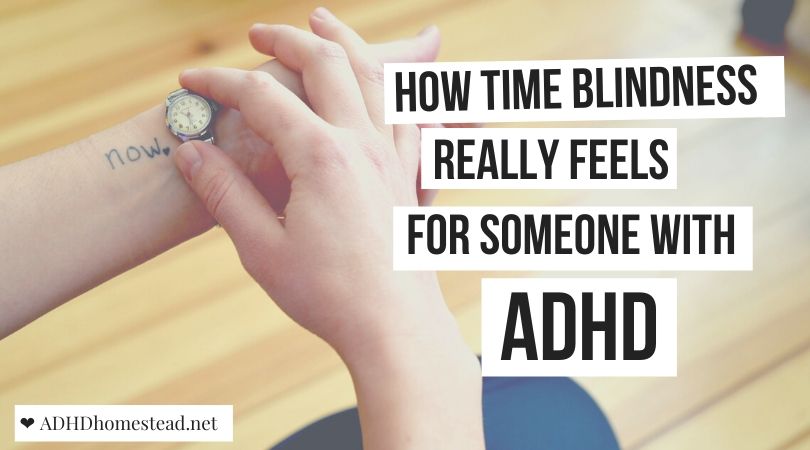
Our perception of time — or lack thereof — lays the foundation for our biggest struggles. As Dr. Russell Barkley explains it, ADHD “disrupts the fabric of time.” And while time feels like it should be a simple concept, ADHD’s time-blindness finds some complicated ways to hurt us.
Neurotypical people may wonder, what could be so difficult about looking at your watch? How could you not know how long it takes to get ready for work in the morning? How could you not have realized you didn’t have time to mow the lawn before our date?
ADHD makes these most basic life skills exceptionally difficult. Time-blindness causes all the screw-ups mentioned above, and more. It kills our self-esteem and exacerbates our emotional volatility. It can even put us in danger of seriously harming ourselves.
Time-blindness hurts ADHDers’ relationships with ourselves and others
Time management has deep ties to love and respect. Let’s say I promise to meet you at a restaurant for dinner at 6:00, but I show up a half-hour late. How do you feel, having made excuses to the server and finally ordered a glass of wine alone at a table for two?
Showing up late to dates, meetings, and everything in between sends a message: I valued you less than something else. A person left waiting every time feels they’ll never be as important as literally anything else you could be doing.
But this isn’t true.
For people with ADHD, intentions and actions don’t always line up. We experience an agonizing dissonance between the self we know and the person our actions present to the world.
Our culture starts teaching time management to children in preschool. A five-year-old knows how to stop one activity and move on to another. Imagine the pain an adult with ADHD feels when we fail at a basic life skill. It’s easy to forget these skills are learned, not innate. People with ADHD don’t learn them easily. Someone with undiagnosed/untreated ADHD may not be able to learn them at all. Failure doesn’t mean we’re irresponsible. It means we’re struggling with a problem we lack the tools to fix.
To everyone else, it looks like we don’t care. And that hurts us, too.
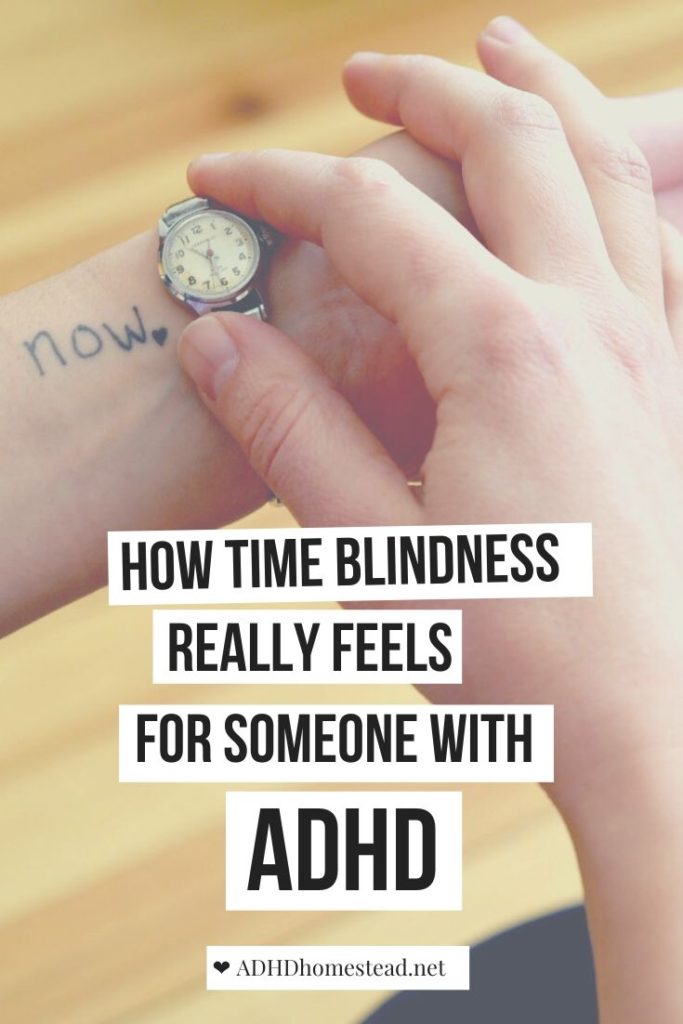
If you have ADHD, time-blindness is as intentional as colorblindness
Yes, really. I’ve heard it from strangers and I’ve heard it from my own family: how could X ADHD behavior not reflect intention?
A colorblind person can’t perceive differences between certain hues. They know those differences exist — and other people can see them. A time-blind person may know we should look at a clock more often, or leave work in time to meet a friend for drinks. That knowledge doesn’t help us when we forget the clock, and maybe time itself, exists at all. When we don’t perceive time passing, we also don’t perceive you waiting at a table alone for us. We don’t feel a deadline inching closer.
It’s one thing to know a fact in your brain: this flower garden is full of rich, beautiful shades of red and green. I need to make sure I’m on time for this meeting. It’s quite another to experience it, at a sensory level.
[clickToTweet tweet=”Showing up late to dates, meetings, and everything in between sends a message: I valued you less than something else. For people with #AdultADHD, intentions and actions don’t always line up.” quote=”Showing up late to dates, meetings, and everything in between sends a message: I valued you less than something else. But it’s not true.”]
Time-blindness is dangerous
A faulty perception of time gnaws away at our relationships and self-esteem. It also presents an immediate danger to emotionally volatile ADHDers.
Hyperfocus, the “in the zone” state many praise as a so-called ADHD superpower, is especially disruptive to our sense of time. And it happens with emotions, not just activities.
Our inability to perceive time outside of the present moment fans the flames of emotional hyperfocus. This may seem charming when an ADHDer can only see the excitement or good in the moment. When we’re happy, we’re 100% happy. But what goes up also goes down. A negative event can trigger intense, even frightening emotions. We can lose sight of our worth in relationships, or life in general.
I once showed up for a doctor’s appointment on the wrong day, after having asked my husband to stay home from work to babysit our son. As soon as I got back into my car in the parking garage, my negative self-talk spun out of control. This would be my entire life: making mistakes like this. My family would be better off without me. My presence in the world could only drag others down and do them harm. And so on.
For someone with ADHD, a simple mistake like this can lead to obsessive, inescapable thoughts of self-harm. It takes some brain-wrangling skills to snap out of it. I don’t see these skills taught or discussed often enough. ADHD puts us at a fivefold risk for deliberate self-harm. We can’t afford to ignore the emotional impact of time-blindness.
People with ADHD suffer plenty for our mistakes
If you have ADHD, I bet you’ve been nodding the whole time. Time-blindness is one of my most popular blog topics. Our perception of time contributes to so many painful experiences, and so much misunderstanding.
If you love someone with ADHD, learn about time-blindness. Watch the video embedded earlier in this post. Remind yourself that time blindness isn’t personal. It doesn’t reflect an ADHDer’s values, intentions, or feelings toward you.
This is especially important for parents of young ADHDers. Our children’s identity and self-worth are formed, in part, by the ways we communicate with and label them. I remember being labeled selfish and inconsiderate, especially as a young teen who should’ve known — and done — better. I understand exactly why it happened. But these conflicts also forged a distance between me and my family. I didn’t know how to reach out and talk about my struggles.
We need both sides of the tough-love equation
When it comes to family, the relationship needs to come first. “Tough” is only half of the phrase “tough love.” When ADHDers make a mistake, we already feel bad. Compounding our negative self-talk with blaming, shaming, and insults doesn’t help. Punishing someone who already feels like a failure doesn’t help. It tears down self-esteem and inflicts yet another wound in the relationship.
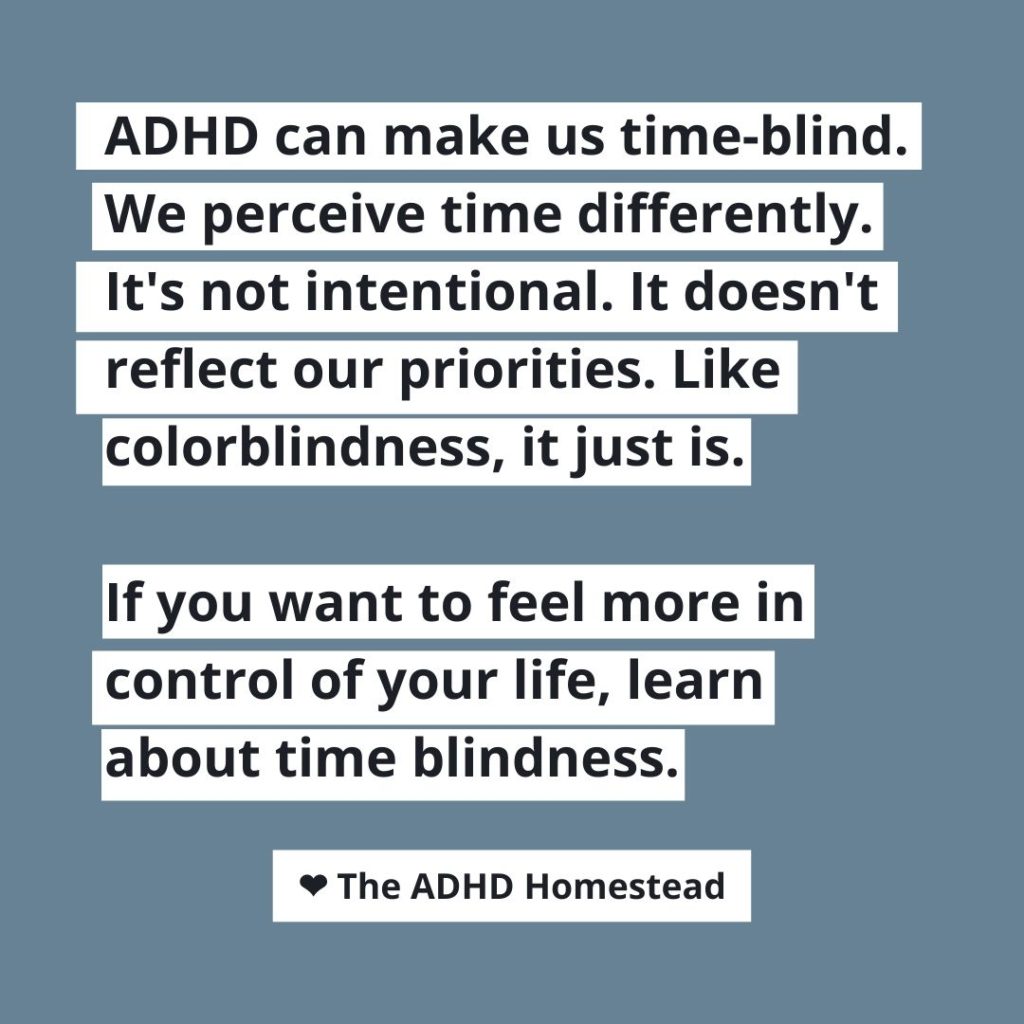
Time-blindness is a big deal. It has real causes in the brain: we perceive time differently, much like a colorblind person perceives color differently. You wouldn’t assume a colorblind person simply doesn’t care enough about distinguishing red from green. Neither should you assume a person with ADHD doesn’t care enough to manage time properly.
That said, letting ADHDers get away with bad behavior doesn’t help anyone, either. That includes bailing us out and protecting us from the consequences of our mistakes. Colorblindness doesn’t give anyone license to ignore traffic signals. It also doesn’t make it okay to demand someone sit in the passenger seat and call out the color of the signal for every ride. Likewise, we ADHDers aren’t doomed to go through life hurting people and letting them down every day, nor should we put the burden of responsibility for our time blindness on others.
We need to develop our own ways of navigating the world. Find strategies that work with our unique perception of time, rather than working against or ignoring those differences. In this way we can be accountable, show up for ourselves and the people we love, without feeling browbeaten about our supposed lack of caring.
If you want to live a better life with (or adjacent to) ADHD, you need to make that paradigm shift first. Only then can you open yourself up to the information and strategies that lead to real solutions.
Updates:
- New images added January 7, 2020
- Audio narration added April 15, 2020
- Concluding section expanded June 26, 2020
- Improved audio narration added January 4, 2023
Hey there! Are you enjoying The ADHD Homestead?
Here's the thing: I don't like ads. I don't want to sell your attention to an advertising service run by the world's biggest data mining company. I also value my integrity and my readers' trust above all, which means I accept very few sponsorships/partnerships.
So I'm asking for your support directly. For the cost of one cup of coffee, you can help keep this site unbiased and ad-free.
Below you will find two buttons. The first lets you join our crew of Patreon pals and pledge monthly support for my work. Patrons also have access to my Audioblogs podcast. The second takes you to a simple donation page to pledge one-time or recurring support for The ADHD Homestead, no frills, no strings. Do whichever feels best for you!

Jaclyn,
I hope people click and read this! I love how you explain what it’s really like to live this way.
So often people think we don’t care enough. ugh
I actually overestimate how long things will take and generate all this anxiety about being late.
will be sharing!
Thank you, Liz! I’ve been mulling over this one for a while. I know it’s a topic that resonates with a lot of people, and I want to do it justice.
I remember when I found out that my lack of a sense of time was actually a symptom of my ADHD. I felt so validated! That was years ago, and today, I’m only a little better with time as I was then. I’ve heard it said that time is a sixth sense…and, apparently, one I don’t have! Taking the bus has helped me some with time, such as planning backwards from an appointment time to what time the bus could arrive at that appt and, based on what THAT time is, then figure out the time to get on the bus, as well as what time I’d have to leave the house by to make it to that bus in time. It took years to figure this out. I also would arrive at appts on the wrong day, and even a wrong time! I pull out my appt card to show that I have the right day and THEY are wrong, but the card states they are right…doh! But what gets me the most is that I have a passion for music…and when I joined choir in high school, the first thing the teacher said was, “Music is time.” I thought, “Oh, sh*t…” I’ve recently started taking piano lessons (which I’ve been waiting my whole life for!!!), but I cannot grasp the time/rhythm/tempo aspect of it, and it’s extremely frustrating! I’m scared it’ll always be like this. I’ve had it planned that I’m going to sit through a minute and feel what that feels like (which would be a tempo of 60), and once I get that feeling down to move on to another tempo and see how that feels. But I haven’t done that yet. Sheesh, it’s only a minute yet I’ve put it off over and over. Maybe I should go do that now! lol Thanks for the article; I like feeling not so alone in this struggle.
Thanks for writing this article. I wish I could show it to folks that I know but they’d probably just roll their eyes at me and say I’m making excuses.
I got the time blindness bad. I lost a job due to chronic tardiness. I’ve missed flights because I’ve misread airline tickets. I missed almost all of my grandmother’s funeral. I’ve screwed up relationships with friends because I run late and leave them waiting, or we miss part of a movie or concert. My husband has come to accept my tardiness as something he just has to learn to live with, but he still thinks I run late on purpose. The times I’ve piped up about it being symptomatic of ADD, people come back with “But you’re on meds” or “Bullsh*t, you have tools, just use them”. I feel like my chronic lateness forfeits my right to speak up for myself in situations. What right do I have to complain about someone saying something hurtful when I can’t even be bothered to get there on time in the first place?
I remind people that they HAVE to give me a SPECIFIC time if they need something done. I do not do well with “whenever you get around to it”. You won’t get what you need at all from me that way. Other than that…I keep thinking I can change the time blindness and it’s no more possible than making one’s self not colorblind, if they’re colorblind.
The good news is, the time blindness has made me more sympathetic to it in others. Usually I bring a good book with me and use the extra time to catch up on my reading.
J,
I’m sorry this has caused you so much grief 🙁 My husband reacts this way to me not hearing things sometimes. I can’t understand speech over white noise/chatter. He can’t fathom how this could be unintentional because it gets so bad. Sometimes the way our brains work is just so far outside others’ experience, they can’t imagine us not being able to choose differently.
Thanks, Jaclyn.
Omg! Me too!!! If there are 3 or more noises/voises going at one time my brain just blocks them all out & all I hear is blah blah blah. It drives me crazy!
I didn’t even realise this was a symptom! I have actually feared for the last 10 years or so that I’ve been steadily going deaf, but I do actually have really good hearing! I even say to people I’m “half deaf” so they speak louder to me, especially when there is competing noise.
I can’t hear over other noises/voices going on and I’m sure i drive my family bonkers asking them to repeat themselves when I “can’t hear” them.
I actually have even gone so far to say to them they need to face me when they speak so I can lip read to help me hear what they say!
I’ve suspected for a number of years now that I am on the Autism spectrum and some people with Autism also have ADHD (my child who is also autistic was investigated for ADHD)…
I just wish I knew where to start in my local area to get a diagnosis as an adult! I’m concerned any professionals i see will think that I’m mid-30’s and it’s something that’s never been looked into properly before, no one else has raised concerns about me (i.e. parents, teachers, etc.) I’m probably just making it all up!
I was diagnosed at 35! Because it is easy to overlook in girls, many women aren’t diagnosed until they are adults. Only my brother was diagnosed and medicated when we were kids, but we ALL have it (and I am positive my mother does too!); my 2 sisters and I were diagnosed as adults, and I wouldn’t have even known to look for it if they hadn’t been diagnosed first. I just thought I was bad at adulting, and even though I have multiple degrees, I must just be stupider than other people, because they can seem to handle these things and I can’t.
My grandma had 9 husbands and countless jobs along with passing nursing school and that was her last profession. I’ve been married for 25yrs so the relationships didn’t seem to bother me. But boy school did! I was always a good student. I just hated it because it was boring! I know I got it from my grams!
Find a general md you trust and ask them to recommend a doctor that gives the written test. A general md gave me mine. It completely explains why when the going got tough in college I’d quit and go to work. But I did that back and forth for 10 years!!! I wished I’d had meds growing up and especially in college to see if I could have finished. I left with a 3.833gpa. I’m not stupid. I just panic when I’m overwhelmed. It sounds like you have it. And the older I get the more extra noises get on my nerves! If I’m home alone I don’t turn on the tv or radio so I can concentrate on what’s in my head that I need to do. It’s so calming. 2 of my 5 kids have it but it’s helped me know how to help them. Good luck! Oh and there are online tests you can take for free.
My wife does the same with me; if there is a lot of noise in the room or a distraction I might hear her but I can’t process it in real time. Oddly sometimes I can figure it out after the fact though.
Very true.. if it doesn’t have a deadline it doesn’t happen for me. I created a bunch of work-arounds to prevent forgetting things. I have to put it on my calendar or I’ll lose track of time with whatever I’m working on and forget. I put almost everything in my online calendar, set alarms for everything (sometimes multiple alarms), and it mostly works.
Jaclyn,
Thank you so much for the article on time blindness. I haven’t ever read an article that describes my situation with time almost perfectly. I should have connected it with my ADD, but haven’t. It’s a daily battle with me to try and get to places on time. I so want to change in this area! I will keep reading to understand how my brain works.
So glad to hear it resonated with you. I’ve had that experience many times: the sudden realization that something I’ve dealt with my whole life is connected to my ADHD.
I have a really hard time getting motivated and I feels like I can never catch up. It’s like all of a sudden I want to do the totally opposite of what I’m supposed to be doing . I’ll want to clean my room when I should be getting ready to go to somewhere. I forget to check the time while I’m getting ready for work because somehow time isnt an issue, till it is. Its almost like I don’t care but I do. To make matters even worse I get migraines and then I really can’t think trying to stay positive but ADHD it sucks because the way people look at me, makes me feel more misunderstood and alone. I do the best I can, why isn’t there more understanding for ADHDers? Its like the world wants us broken.
Looking through my journals from when I was a kid, I realized recently that this has been a problem my whole life. It’s like there’s a force field between me and the thing I’m supposed to do. And like you said, sometimes it’s an activity that would be perfectly fine — like cleaning your room — except the timing is all off. It’s definitely frustrating.
hey at least we’re not alone, even it feels the way. Maybe we’re on a different time line than everyone else is… it sure feels like lol!
Amazing article,thanks so much for writing this related so badly.
I’ve missed trains, nearly missed planes (losing phone at one point as I was rushing to make it). Been an hour late and more to dates, missed GP appointments and plays I really wanted to see, been consistently late to jobs (one time vomiting on way to win because I was rushing so much. That was a job where my manager would reprimand me if I was a minute late), been 30 minutes late to job interviews, and had people just leave because I didn’t show up on time.
It’s a daily struggle to feel and look like a professional, responsible and considerate person with this issue. Thanks so much for highlighting how much we do actually care. X
I don’t know about you but I really get sick of having to try so freaking hard every day. Worried about everything because I’m late, say something totally dumb, or I can’t make myself shut up, I definitely go above and beyond sometimes to beyond and others start not to like me because of it. God please help!!! So btw ur not the only one. At least you have a job☺
Totally agree with both of you. Sometimes I get so frustrated. And I do try to go above and beyond whenever I can, to counterbalance the things I know I’m going to screw up later. Sigh…
But how do we help our children overcome this?
I think awareness is the first step. When I was a kid, I don’t think most parents understood this stuff. I know my parents didn’t. So any feedback I got came in the form of punishments or character judgments.
That said, my husband sometimes says he thinks his parents didn’t let him suffer the consequences of his time blindness enough. His mom stayed home with the kids (mine didn’t) and had the capacity to bail him out or overlook stuff that I had to learn to navigate on my own.
So there’s a careful balance between too much and not enough support. I write mostly for adults, but a lot of the advice in my posts can be adapted to people trying to help kids as well.
Focus not on time but events and routines. instead of a strict schedule – pick 5 things a night and let them do them in a row.
❤ Just know there is someone in FL going through it.
I really appreciate this vivid portrait of the daily frustrations of living with ADHD. My husband and daughter both have ADHD and suffer from time blindness. Every morning my husband struggles to get out of bed, move through the routine of getting ready for work and out the door. If there is a meeting or appointment that he has, he is likely on time for it about 10% of the time. He has learned ways to manage better and his lateness now falls within about a 10-20 minute window which is usually forgivable. My daughter faces the same struggles, and because she is younger, this is more pronounced. I think for both, there is this constant sense that the world moves at a different pace than they do and the only way to manage is to spend their time trying to catch up. What a terrible drag on one’s energy and motivation this is! I think that understanding this issue as part of their brain wiring is an important first step to learning how to manage it better. So many comments on this blog talk about the relief of understanding and no longer feeling alone! That knowledge and insight is very empowering.
Time blindness is also connected to some of the qualities which I hold most dear in my husband, who has learned to use it to his advantage. He is uniquely capable of getting lost in a moment and seeking great pleasure in savoring its joys. As a writer, my husband often has very tight deadlines and has to work punishing hours. Up against it, when I would never be able to relax, he can spontaneously get on his guitar and become lost in playing and singing for half an hour. Or sink into a nap. Or spend a bit of time with a family member. He throws himself into each of these diversions like he has all the time in the world and this capability allows him to relax and break from his stress. I have tried to learn from him over the years and it is hard work for me. Not so for him. This naturally helps to feed his creativity. My daughter is also very good at savoring a moment in this way. It is a strength which in some ways, can be a true advantage and should not be overlooked.
Learning particular strategies to manage the time blindness can be helpful. Today’s technology makes that even easier. As a coach, I am currently completing an MA in Educational Therapy. Children and adults can definitely benefit from working with an educational therapist to develop strategies that work best for them and can help hold them accountable to their goals and actions. Educational therapists can assess how ADHD is affecting you in school, in work, and in your life. They can help you understand the strengths and weaknesses in your learning style and work with you so that you can set goals and accomplish them. If you want to find such a person in your area, you can check out the Association for Educational Therapy.
A lot of people advocate blocking time and creating a strict schedule. I live and die by my *routine*, but the schedule thing has never worked for me either.
yea no matter how hard I try – that clock is pointless.
This time blindness thing is by far my hugest downfall & had you are so right when you said it can wreak havoc on ones self esteem!! I’ve also showed up on the wrong day for a Dr appt..actually I’m thinking I’ve done it twice! And my Dr (at the time) was a 45 min drive. Thank goodness they were understanding (happened to be my psych who I saw for my ADHD)..anyway, not only am I constantly beating myself up about my COMPLETE lack of time awareness but my bf & father of my 4 yr old daughter constantly gives me hell about it. Yes im late 2 pretty much evrytng & while I’m driving, freaking out, cursing myself in my mind, he’s complaining to me telling me how inconsiderate& selfish I am & how the world doesn’t revolve around me..etc etc also (as im sure you know) its not just appts that are affected by this time blindness deal..it’s practically EVERYTHING! 4 instance, he’ll ask me how long it’ll be before I’ll be ready (we’ve been together almost 8 yrs so I don’t understand why he still even bothers asking bc it’s the same every time..I’ll say I rly don’t know but when he insists on a time I’ll give him one always thinking surely I’ll be able to get there by then but it’s like something always ends up happening that makes it later than I said & when I pick him up there goes the complaining again. I mean I truly get it..I realize it’s annoying but I honestly cannot help it! Most of the time I’m afraid to even look at the clock bc I know it’s gonna be later than I think it should be..I mean I know everyone has 24 hrs in a day but I honestly feel like mine only have 12! Any advice on how to deal with my bfs constant voicing of his disapproval/aggravation about my super annoying problem!?
Of all ADHD’s challenges, I’ve always taken others’ judgement the hardest. Most of us have heard it all our lives: first from our parents, then from our partners, and probably from a bunch of other people in between.
In my experience, that anger and judgement is worst when those close to you aren’t educated on ADHD.
My parents never knew to suspect ADHD, and thus they attributed all my mistakes and bad behavior to my character. For people with ADHD, our actions and our intentions can be really disjointed.
I’m currently working on compiling a few pieces of downloadable content — the first of which will include and expand on info from this post — to make key ADHD info more accessible for my readers.
For now, I can tell you the single most important thing my husband and I have done for our marriage is learn more about how our brains work in general and how ADHD affects brain function in particular. We started by reading Gina Pera’s Is It You, Me, or Adult ADD? which targets partners of people with ADHD.
The more you read about the brain science behind ADHD, the more you begin to understand that this person is not selfish, inconsiderate, or irresponsible. And of course the more you learn about how to support and work with your brain, instead of constantly fighting yourself.
It happens with all kinds of impairments. I can’t understand what people are saying if there’s a lot of white noise — for example the water is running while I wash my hands and my husband is trying to tell me something. He spent *years* insisting that I had to have heard him, I must be doing this intentionally, etc. Sometimes people just cannot wrap their heads around an impairment.
It sounds like your boyfriend is having trouble with the concept of ADHD and time blindness. While it’s really helpful for you to learn more about your ADHD, it’s just as important for him to educate himself on — and really, truly understand — what’s going on in your brain. It’ll save everyone a lot of frustration and hurt.
Thank you for providing a name for this condition. This goes deeper than the article mentions. It can affect your possibilities and opportunities for advancement. The ability to effectively manage your time is consider a key characteristics of executive functioning. You are considered unreliable or irresponsible. It can affect you financially. I forget to pay bills which then compound. Again, I am labeled irresponsible and unreliable. I truly wish that more scientific research would be conducted on this topic. I would loved to be finally considered for what I could actually accomplish and not the results of something I try earnestly each and everyday to control. Even with meds, I still often fall short.
My shrink for 22 yrs understood this but retired at 80. My new shrinks say make a schedule! So for 4 yrs I overpay my estimated income taxes and and am years late in filing. I will probably get hauled to jail.
“Make a schedule.” 🙄
If it was as easy as that, wouldn’t we all be super organized already?
Hey, I’m 18, have ADHD, and just found out about time blindness from Tumblr of all places. I’ve struggled with time management my whole life. I’ll think that an event that happened years ago happened a month ago or vice versa and I always thought that it was just me, that I was just really bad with timelines.
I have always been told that people with ADHD have a hard time with time management, but they never elaborated about how. How are they bad with time management and how do they even function if it’s that bad, but now, thanks to you, I finally understand how that works.
I’ve always just thought that it was my fault alone, I realize that I could try a little harder, but there’s always something else to focus on that distracts me from focusing on my own flaws and trying to correct them, then I’ll be focusing all-in on that and completely forget about anything else and it’ll just fall through the cracks. That’s not the point though, my point is that this article really helped me feel better about some of the time management errors I’ve made.
It helps me understand why I fall into such a deep, dark black hole when I make even the simplest of mistakes. A tiny mistake because of my own time management skills (or lack thereof) and suddenly it’s like I hate myself, which always confused me because I generally have a deep love for myself in the way that everyone should love themselves and who they are. I suddenly will feel like my family hates me, or at least should when I know that that’s not the case.
And then, when I crawl out of that hole, I’ll think back on what just happened and wonder why I was crying on the floor of my room because I failed to turn in a single homework assignment on time, even though I have a 504 plan and am allowed extra time on assignments. It’s all very confusing, but this helps a lot, I think I’m going to start writing in a journal (something I’ve been avoiding for years because I have siblings and you never leave evidence for siblings to find) to try and keep track of my mood and my general experience with life, ADHD, time blindness, all that good stuff.
Dang it, every time I go to write something like this, I end up writing a huge ranty thing like this. I guess I just laser focus on getting all of my thoughts out and forget that I’m even writing anything at all. 😀
Welcome! I’m so glad this post helped you. The whole ADHD/bad time management skills stereotype (which is admittedly there for a reason) misses the point. If only a basic thing like “time management” were the only thing affected here! As a teenager I suffered hard from the emotional hyperfocus and had no idea why it happened or how to manage it.
I did, however, keep a notebook. I still have all my notebooks to this day. They go back ~22 years at this point, to my first one in seventh grade. I had a sibling but she was 14 years younger and easy to lock out of my room even after she got out of the crib 😉
Hahaha, yeah my siblings are all only a year or two younger than me, so they would get into my stuff to annoy me when we were little. That’s very rare now, I guess we grew out of it. I actually just started writing in a journal today, I’m hoping to understand myself better by keeping track of what’s going on in my life and how and when my moods change.
I still don’t fully understand the emotional hyperfocus, but I’m hoping that this journal, and more research, will help with that.
Plus, it might help me understand more about how my medication effects me personally and what’s caused by ADHD, what’s caused by my medication, what’s just normal teenager stuff, and what might be caused by other stuff.
I’ve been having a bit of a rough patch recently, but I’ve sought out professional help and I’m now just trying to figure out if it’s just stress from trying to get through senior year or a clinical problem.
Anyway, my point is that I really appreciate you writing this, it helped me learn something more about myself and how it could effect my life if I let it.
This is THE BEST description of ADHD I have ever read. How do you see into my brain?
Okay, now what do we do about it? Or do we have to buy your book?
LOL. While I obviously recommend my book, it specifically covers staying organized with ADHD. You can also peruse the archive here — currently over five years of posts — especially my posts about hyperfocus.
Wow! I didn’t know that what I’ve suffered from all my life, now 62, has a name & is a real condition.
I’m so happy I’ve finally found out about this. Thank you so much.
Welcome! And I’m so glad this resonated with you 💛
This is a really useful article and I desperately want to share it but I can’t because this sentence contradicts your entirely valid and important point:
“To be fair, letting ADHDers get away with bad behavior doesn’t help anyone, either. That includes bailing us out and protecting us from the consequences of our mistakes.”
The entire rest of the article is fabulous but “letting ADHDers get away with bad behaviour” is akin to saying “letting colour blind people get away with not seeing colour”, or “letting paralysed people get away with not walking”. It is so so disappointing in such an important piece of information. Please can you consider removing this one ridiculous sentence.
Hey Emily — thanks for your note! That sentence actually gets at a much larger, more complex point that probably deserves its own post. I suspect it lands poorly here because of word choice, which I may consider revising for clarity.
By “bad behavior,” I don’t mean time blindness itself. Time blindness isn’t a behavior. Hopefully that much is clear from the rest of the article. Interestingly, some have tried to move away from using the term time “blindness.” It’s often considered ableist when used outside of actual vision impairment. However, your reaction to my post demonstrates my reason for keeping it: in this context, it’s used as an analogy, not a derogatory, and it’s a powerful one. It drives home the point that we fundamentally perceive the world differently, and therefore our relationship to time should never be seen as a behavior.
However, I’ve also gotten blowback on other posts for giving ADHDers too much of a pass. In those cases I disagreed and told people so in no uncertain terms.
In this case, I didn’t want to present a post that people would take away as an excuse. It’s an explanation for many things, but it doesn’t mean we can never be accountable to others. I can know my husband didn’t intend to arrive thirty minutes late to our anniversary dinner, and I can know this lateness does not directly reflect his love or respect for me. However, this doesn’t mean I should expect or accept this treatment long-term. A red-green colorblind person still must obey traffic signals. My husband has told me he wishes his parents had held him more accountable and helped him learn coping strategies as a kid, before he felt set in his ways.
In other words, the time blindness is a permanent part of us and we need to learn to work with it. It doesn’t make it okay to do hurtful things to other people. It does require us to learn different ways of operating in the world. “Just pay attention to the clock” doesn’t work any better than “just look at the color of the traffic light.” We can’t make it others’ responsibility any more than we can ask someone to sit in the passenger’s seat and announce the color of every signal. That’s what I meant by that sentence: that knowledge about time blindness is power.
That said, I will take a look back at it and see if there are any small tweaks I should make to clarify. That’s the beauty of online content!
Thanks. I absolutely agree that everyone is accountable, even if not strictly at fault, for their behaviours derived from neurological difference. I guess for me appeasing the people who believe you are giving ADHDers too much of a pass is ableist, and doesn’t take account of the constant criticism, judgement and discrimination we receive. I read this (excellent) article as a counter argument to that tide of awfulness we endure, and wanted to share it so that ADHDers could feel vindicated, and others could have a deeper understanding and be more compassionate. I feel I can’t because that one sentence provides licence to the people who judge us to say “yeah but she says it is bad behaviour and you need to change it anyway”, even if that was not your intent. I don’t think anyone has the right to surrender to hurting others, even if it is difficult or near impossible to change. However, we get enough of this already and have our whole lives. What we need more of is compassion, and the rest of your article provide the knowledge to empathise with our experiences, the best tool for compassion. Thanks for answering. I really do think the rest of the article is awesome.
Sorry, I shouldn’t have mentioned the other article — totally different situation and not really applicable here in hindsight. To clarify my point, I never alter my content to appease anyone, period.
That’s not to say I don’t appreciate or listen to feedback, or that I’ve never changed anything after hearing from a reader. I do, and I have. But I take my responsibility to my readers and the integrity of my work very seriously. Any alterations to my message happen because I believe they’ll bring me into closer alignment with my mission, not because someone didn’t like what I said.
Your comment in particular made me realize I’d glossed over an important point and left it open to misinterpretation. I hadn’t wanted to veer off course from the article’s primary focus, but I erred on the side of too much brevity. I’ve updated the concluding section of the article to read a little more like I’d originally intended. That’s part of the beauty of online content!
There’s a short term memory component to ADHD also; the out of sight out of mind SQUIRREL thing drives me crazy sometimes. I once forgot my work ID four times in the same week because the table I usually put them on with my keys was moved somewhere else. I put my ID in my wallet so I’d not forget it. I forgot my wallet a couple times the next week for the same reason. I started putting my ‘tomorrow’ stuff in a new place. Using technology and creating habits has helped a lot but I still have occasional problems.
I have the same issue! Anytime something changes, it throws things off 🙃
This may be well outside anyone’s experience here, but any thoughts on talking to a boss who seems to have (undiagnosed?) time blindness and is causing major burnout for his employees? I don’t want to arm-chair diagnose, but he really does seem to be drastically bad at managing both his own time and his employees’ (small company that he’s somehow kept growing for 10 years). He sets wildly unreasonable time expectations for projects and tasks (even his own), plus doesn’t factor in time for “transitional” steps like cleanup between tasks, will overload us with new projects then question why the old projects have been neglected, he’s constantly rushing late to meetings with clients and not scheduling enough time for very important staff meetings, to the point that they get delayed for weeks, he forgets about his own personal appointments, zeros in on tiny sources of time inefficiency but seems oblivious to the large ones, texts us very important daily schedule updates often only late the night before and sometimes not at all, you just get a surprise in the morning… People have talked to him about the last problem and he’s *tried,* unsuccessfully. He’ll get “in the zone,” his own phrase, and work without breaks, only partially aware that most people suffer fatigue long before he does (he knows and has said so but I don’t think he realizes how large the discrepancy actually is). His solution to all this has consistently been to tell us we all need to work faster. A few long time employees have been mostly able to keep up but not the majority, and no one completely can.
I like this job and want to be sympathetic but I’m also really angry with him for the pressure he puts on everyone. I want to tell him but I don’t want to make it seem like I’m bad at my job because I can’t keep up/do everything he expects. Sometimes I want to quit and yell at him why, but feel I should at least talk to him rationally first. I have no idea how.
This is a tough situation, and I think I’ve been in a similar one! You didn’t mention whether the boss has any kind of intermediary or assistant to act as a buffer between him and his team. In my case, that move helped all of us a lot.
A good assistant will complement the boss and fill in where their natural abilities leave off. They can act as a filter, reducing communication strain but also providing pushback when the boss’s expectation are unreasonable. Of course this requires a very trusting relationship and a competent assistant!
Anyway, my observation was this helped temper the boss’s more stressful-to-us qualities a lot. And it’s a move that can be couched in helpful terms: “you’re a good leader for this team because of XYZ qualities, but you’re bogged down by these other tasks that an assistant could help with. It’s a totally worthwhile investment!”
Plus, sometimes people with that level of — ahem — charisma are promoted for everything but their executive functioning skills. Paying someone to take control of their daily schedule can be a HUGE benefit. That person would, again, be the boss’s opposite in this way, knowing how long transitions take or that there’s no way he’ll actually spend only 30 minutes meeting with so-and-so.
Sorry if that’s not helpful! Like I said, it’s a tricky situation that would benefit greatly from a mediating force like an assistant or someone else taking on more of the administrative burden and pushing back on behalf of the rest of the staff when needed.
There was someone in that role for a while but he left. Thanks for your advice, I do appreciate it. I was kind of posting out of desperation at this point, but I finally decided to just quit my job. There were other problems too, and I decided none of this is mine to stress over or solve.
Jaclyn, this is the first time I have read anything about time blindness and reading about it made me cry because for the first time it was like someone actually understood what I have been struggling with for almost 50 years.
Unfortunately, your conclusion was crushing, especially because it was a complete disconnect from what you had just written. In the end, I was suddenly reading the same shaming of my disability I have struggled with my entire life. How can you write that “letting ADHDers ‘get away’ with ‘bad behavior’ doesn’t help anyone, either. That includes ‘bailing us out’ and ‘protecting us’ from the consequences of our ‘mistakes’.”, when you just wrote that “knowledge doesn’t help us when we forget the clock, and maybe time itself, exists at all”?
We forget about time, have trouble gauging time, have issues with short-term memory, get distracted easily, become hyper-focused, and get overwhelmed, because our brains are not functioning properly and it is difficult for us to understand time because it is an abstract concept, which is much more complicated than simply remembering to switch the colors red and green on a traffic light, so why would you call the problem a bad behavior? This is exactly the way every person who doesn’t understand and doesn’t believe in ADHD thinks about us. They think we are trying to ‘get away’ with ‘bad behavior’ just like you said and it completely contradicts what you wrote previously.
People who suffer with ADHD do need protection because it is a disability that may be discriminated against and putting protections in place helps people keep their jobs. The article starts off sounding like groundbreaking information discovered in the medical field until a condescending person finishes the article by blaming individuals for their impairment. The conclusion does not make sense and it was upsetting to know that once again nobody really understands the depth of this impairment.
Hi Mary,
I’m so sorry that paragraph was hurtful to you.
Ironically, I recently added the sentences after the ones you quoted in response to someone making a similar comment to yours: that my words equated ADHD and its impairments to “bad behavior” when that could not be farther from the case.
This is something I’ve been reflecting on a lot lately, for my own reasons, and I’ll probably write a full blog post about it eventually.
I’ve encountered a good many people, both in real life and online, who seem to think settling for less is part of our lot in life with ADHD. That of course we will hurt others and ourselves, of course we will let the people we love down, because we don’t control any of this. Frequently. Maybe daily. That is heartbreaking — and untrue. We don’t have to settle for a life of isolation, frustration, and sadness.
At the same time, there are also people out there who will tell you ADHD is only an impairment if you choose to think of it that way. It’s a “difference” we and others should learn to embrace as a gift. This is just the way we are!
I find this equally heartbreaking and untrue, especially after having watched marriages fail and people get hurt because of it.
ADHD or no, we are still responsible for the harm we cause others. That includes direct harm in the moment and long-term harm from one partner constantly covering and picking up slack for another.
When I see people proclaiming their ADHD as a gift, or something they’ve outgrown and/or learned to embrace and work with, I often see a long-suffering spouse or assistant in the background. This person makes the “gift” narrative true by subjugating their own needs, desires, and sometimes mental health in order to fill in the gaps.
That’s what I mean by bailing out and sheltering from consequences: leaving another human being responsible for bearing the full burden of our time blindness and its impact on our lives. That hurts everyone, including us. Letting someone “get away” with socially unacceptable or downright hurtful behavior — for example, leaving your date along at a restaurant for your anniversary dinner — because that’s “just the way I am” robs us of our agency. My personal spiritual beliefs probably play into this, as I firmly believe hurts I cause others also hurt me. Believing I have a life sentence of hurting others because of my ADHD and associated time blindness would cause me so much unnecessary suffering and keep me from living up to my full potential.
It’s for this reason I follow those statements up with these words: “…we ADHDers aren’t doomed to go through life hurting people and letting them down every day, nor should we put the burden of responsibility for our time blindness on others.
We need to develop our own ways of navigating the world. Find strategies that work with our unique perception of time, rather than working against or ignoring those differences. In this way we can be accountable, show up for ourselves and the people we love, without feeling browbeaten about our supposed lack of caring.”
No, someone else simply telling us we “can’t get away with” harmful actions won’t help, nor will assuming those actions spring from our true feelings or intents — as I point out earlier in the post. But neither should we respond to occasions when we’ve hurt others or treated them unfairly with a dismissal that it’s “just the way I am. I can’t help it.”
There are many treatments and strategies that CAN help it. Some of them are hard work and require a lot of patience and forgiveness from the people who love us. But I’m committed to giving people hope that they have the power to build a good life. It’s not out of reach for us. Accountability is part of that.
I would never blame anyone for their impairment, and I am very sorry if that didn’t read clearly here. The only thing I’d blame a person for is, once they know about ADHD and its effects on their life, continuing to ignore or actively work against their brain’s innate wiring because they think they should be able to “just do it the way everyone else does” or “try harder.” That’s as abusive when we tell it to ourselves as it is when others tell it to us.
I debated deleting this, maybe permanently or maybe just moving it into a draft for a future blog post, because my track record with long replies is pretty poor. Perhaps many highly-sensitive ADHDers can relate to the experience of spending time and energy trying to increase connection and understanding, only to learn we’ve made everything much, much worse.
However, I’m genuinely interested in your thoughts on this, if you’re interested in sharing them. Like I said, this is something I’ve been thinking about a lot lately: the intersection of compassion, forgiveness, support, accountability, and effective strategies to manage our ADHD. I’m glad some of this post resonated with you. Sometimes, also, we do just need to read something that makes us feel seen. We aren’t looking for accountability or advice on how to fix the problem, we just want to know we aren’t alone. Hopefully the parts that resonated did a bit of that for you regardless of whether we agree on anything I’ve said in this comment.
Please please don’t delete this reply! I’m a partner of a man who likely has undiagnosed ADHD, and we have fallen into the trap of blame and “well that’s just who I am” craziness. I hope we will be able to understand one another better with your insights and Gina’s book…. At least he is open to trying. I found your comment Soo helpful, I’m copying it to a private notebook I’m keeping for marriage advice.
I’m so glad it was helpful! And at this point you don’t have to worry, I won’t delete it. I tend not to delete things after I post them, for accountability reasons, but sometimes while writing a lengthy response I do realize: no one asked for this many words!
Not only that, lengthy responses can easily worsen conflicts because they give the other party more fuel for their arguments — or simply indicate you’re open for extensive debate on the subject. Sometimes I am open for debate. Others I’m not.
This is a subject that really interests me, and which I do plan to write more about. Accountability with ADHD is tricky. We deserve a chance to be held accountable for our treatment of others, and to learn the skills required to sustain close relationships. At the same time, many of us carry a burden of ingrained ableism and judgement that don’t help anyone.
Anyway, I’m glad these words helped you, and your comment has reminded me I did intend to revisit this comment as a more organized blog post at some point 😉
thank you for putting my feelings on this article into better words than i can. excellent article helping me feel slightly less alone, and then boom, the crushing weight of implied (and impossible) hope of becoming more neurotypical despite being neurodivergent. as if it can be willed away.
The article was great up until the part about not letting ADHD’ers get away with it. Then you went into the ever so common general vanilla “just get better, and try to do better” schtick that I see from those who are just writing fluff pieces for articles. I pay attention to those types of things, I guess others can skim past it and ignore it. I’m assuming that you got to that point where you just wanted to hurry up and end the article with something just to be done with it. It’s probably what I would have done too because it would have been brain wrenching trying to keep focused on the topic for more than you did.
You’re right, it’s impossible to fit an entire topic into a blog post. Mine tend to run long anyway, especially for readers with ADHD, which makes it important to stick to a single purpose for each one. This one was intended to be more about how it feels to experience this and what’s actually going on in our brains (especially re: intentions vs. actions).
I do gloss over it at the end, but I actually love talking about strategies for working with our brains, getting to know ourselves, and bringing our actions more in line with our intentions and values. This is a huge focus of my book, Order from Chaos, where I dig a bit deeper into the hows and whats and whys.
I’m sorry if that mention at the end of the article left you with a “just try harder” vibe. It’s important to me to include a small mention because I don’t want anyone to come away thinking ADHD excuses us from accountability. We are still responsible for harm we do to others, intentional or not. However, the other side of that is not just doing better/trying harder. It’s getting to know our brains more deeply and finding ways to work with and accommodate our needs, rather than forcing ourselves into a mold we will never fit. I write about that best in Order from Chaos, but you can find explorations on here too.
Google calendar is my life savior. Whoever has created it and its features must have known some ADD people. That combined with multiple alarms set to reassure. I also always plan to arrive 30min early no matter what. That way I at least get there by the time I’m supposed (often not the actual 30min early though) Oh! I got forget auto pay on my bills. These tools help compensate for the time blindness tremendously for me.
I would be so lost without Google Calendar!!!
Hi Jaclyn,
I thought your article was great and it really resonated with me as someone with adhd and struggles with time. However I’m a little confused about the “ADHD is time blindness” video that was linked in the article.
Dr. Barkley starts on the right track about the effects adhd has on time and the present, but towards the end of the video it gets a bit blurry and somewhat pseudoscientific and condescending? He starts saying how people with adhd aren’t able to achieve their intentions at all, constantly adrift in present gratification. This seems a bit far fetched doesn’t it? I have adhd but I’m still able to get to where I want to even if it takes me more time and I divert a bit along the way. He makes this point pretty clear and goes as far to say it should be called “intention deficit disorder” as he says people with adhd aren’t able to control their actions and do want they intended at all, which seems kind of ridiculous, and as if he’s trying to come across with some newfound theory, that doesn’t reflect the actual condition and sufferers at all. Or maybe I’m just better at achieving my intentions (possibly with diversions along the way) than other ADHDers I don’t know? What are your opinions about this?
Thanks for this great article though!
Thank you for your thoughts, and sorry for the delayed reply! My personal opinion on this is twofold:
a.) ADHD is a spectrum disorder
b.) ADHD’s manifestation and effects on one’s life depend significantly on circumstances
You may well suffer less from time perception issues than others with ADHD. Similarly, some people seem to get by without daily use of ADHD medication with coping strategies alone, others feel they need it to function effectively, maintain a handle on big emotions, etc. I don’t want to use problematic terms like “severe” or “mild,” but symptoms manifest differently in everyone. Within my own household, there’s a wide range of “severity” in terms of emotional, time perception, and other aspects of ADHD because we are three very different people. So what describes one person to a T may feel off the mark to the next, even though both have ADHD.
Individual circumstances matter too. People come from different backgrounds, have different relationship structures, different jobs, different temperaments…all factor in heavily. All can affect the degree to which ADHD prevents us from achieving or acting out our intentions.
I do agree, however, that ADHD could be described as an inability to consistently manifest one’s intentions. I’ve known many people who feel they’ll never achieve what they want to or present as their “true selves” to the world because of their ADHD. Certainly proper treatment/management of ADHD can counter this. However, as a starting point I can say with certainty ADHD, left unchecked, would have kept me from the following:
* Writing a book
* Having a marriage that lasted more than a five years
* Feeling like an adequate parent
* Maintaining physical surroundings at home that support my mental health
* Maintaining long-term friendships
* Developing closer relationships with family who didn’t always get along
* Behaving on the outside like the person I know myself to be on the inside
Probably could add more to that list but it’s hard to imagine what my life would’ve been without addressing and learning about the whole ADHD situation. There’s a reason it significantly decreases general life expectancy and increases risk factors for accidents, self-harm, and many negative health outcomes.
Never read an article that described this so accurately. Now…what about suggestions/ solutions? Is there a place you can direct me to?
I’m actually working on a redesign of my site that would pull more of my time-related content together under one section. Until that’s complete, I’d recommend looking under my Time Management category or time blindness tag.
I just found “order from chaos” on audible and I absolutely love it!!! I literally have never ever been able to figure out what’s wrong with me??? Jaclyn, I seriously am like….. does she know me?? I didn’t know anyone else did that??!! I thought it was just me??!! And im at the beginning of the book. Im so happy!! I feel validated!! And I feel heard!! And understood!! Thank you!!! Thank you for sharing your story!
Thank you so much for sharing this! It means a lot to hear my words have reached someone. Also, glad you’re loving the audiobook!