Let’s talk about feelings. ADHD feelings.
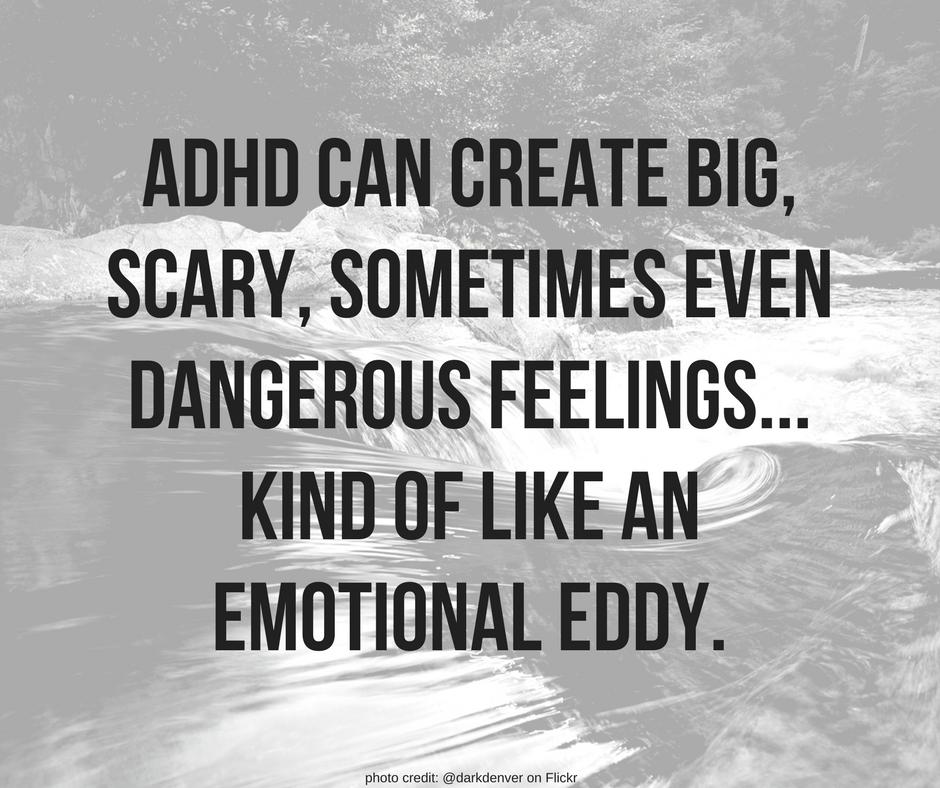
Most people don’t realize, ADHD is way more than forgetfulness and distractability and poor impulse control. ADHD can make our emotions big and scary and maybe even dangerous. Feelings that come and go quickly for others can suck us in, kind of like an emotional eddy.
Growing up alongside a big, gorgeous river, I learned about eddies. They kill a lot of people. They’re powerful and disorienting, and no human can overcome the force of that much water.
But you can get out. You do it by swimming straight down to the bottom, then downstream a ways, and then you try to reach the surface.
It works for feelings, too.
Sometimes, it’s not a big deal (to you).
My ADHD symptoms got worse during our kitchen renovation. All the mess and disruption did a number on my mental health. That I observed and identified this situation — you know, as one of those life circumstances that’ll give a neurotypical person ADHD-like symptoms — was perhaps my only saving grace.
One evening, just before bed, I annoyed my husband somehow. I forget how, and it doesn’t matter, because it wasn’t a big deal. It didn’t need to be a Whole Big Thing. It was a Normal Marriage Thing. A blip on the radar.
Here’s the problem for many adults with ADHD: we tend to latch onto things, and we have a lot of trouble letting go. Poorly managed ADHD blows Normal Marriage Things into Whole Big Things on the regular. It’s exhausting.
Fortunately, I recognized this. I decided — for once! — not to force my husband through a conversation about why he was or wasn’t annoyed with me, and how we could fix it. He wasn’t worried about it, and he wanted to go to sleep. Have you ever kept your spouse up for hours with a bizarre, melodramatic Whole Big Thing whose significance you couldn’t even explain the next day? I have. Let’s just say I wanted to jump on the opportunity to avoid it this time. I got out of bed and removed myself to another room to settle down.
“Forget it” and “drop it” don’t really work with ADHD.
That’s all great, except I don’t know how to let things go. This is why I insist on talking through everything immediately, and why I never, ever want to go to bed angry. I knew I had to drop it, and I knew bothering my husband with drama while he was trying to sleep would make things worse. That didn’t prevent me from suffering.
People with ADHD can get stuck on an emotion. The feeling magnifies itself until it’s overwhelming, even frightening. We can become a person we don’t know. Just like time disappears with task hyperfocus, the spectrum of our emotions disappears with emotional hyperfocus.
It’s easy to sink into a spiral of self-loathing, anger, hopelessness, worthlessness. Once you’re in the spiral, it’s like an eddy: it sucks you down. It won’t let you out the way you came. If you let it overwhelm you, you’ll drown.
There I was, on the couch, gasping for air as those toxic emotions pulled me under.
Swimming to the bottom of the emotional eddy.
I found my way out, albeit by accident.
Don’t ask me how I thought of this in my state of hysteria, but imagined my future self. I pictured myself standing in our yet-to-be-constructed new kitchen. I was at the island, preparing food, surrounded by friends and family. Happy.
I felt the negative emotions dissipate, like a fog lifting.
Turning off a light, touching someone on the arm, or forcing them to get up and get a drink of water can help break the spell of hyperfocus. I suppose I forced my brain to do this in a more figurative sense. I offered a distraction. I walked my brain over to a different corner, forced my mental eyes to refocus, and suddenly I could see the real world again.
Dropping it with my husband took me to the bottom of the emotional abyss. To my surprise, I resurfaced on my own this time.
When we’re out of it, we’re out of it.
I don’t intend this as a how-to, even though I’d love to imagine my words helping someone. Think of this as an ask, of those of you who love someone with ADHD. I want to help you understand how hard this is. How hysterical we get over stuff that’s not a big deal. How, in the moment, it is a big deal. We can lose all sense of self-worth. We attack. We may literally not be able to comprehend the fact that you still love us.
So don’t try to reason with us. Don’t even try to recognize us. Wait for us to come back first, or better yet, try to help find us.
Hey there! Are you enjoying The ADHD Homestead?
Here's the thing: I don't like ads. I don't want to sell your attention to an advertising service run by the world's biggest data mining company. I also value my integrity and my readers' trust above all, which means I accept very few sponsorships/partnerships.
So I'm asking for your support directly. For the cost of one cup of coffee, you can help keep this site unbiased and ad-free.
Below you will find two buttons. The first lets you join our crew of Patreon pals and pledge monthly support for my work. Patrons also have access to my Audioblogs podcast. The second takes you to a simple donation page to pledge one-time or recurring support for The ADHD Homestead, no frills, no strings. Do whichever feels best for you!

Thank you for sharing your experience, Jaclyn. It’s always a relief to be reminded that I’m not the only one who deals with this type of thing.
Sometimes that’s surprisingly helpful! In my childless, 20-something professional, pre-ADHD-diagnosis years, I spent a lot of time (and emotional energy) hearing friends and family tell me “normal people don’t act like this.” It hurt, because I didn’t understand why I was different. It helps to know you’re not the only one struggling.
Also, you were so right when you said that it’s useless to try to “just let it go.” Of course I WANT to let it go, but the motivation is not the same as knowing HOW to move on. Sometimes I’ve found that meditating helps (but it’s really hard to make myself meditate when I’m upset!). I’ve also stumbled upon something that seems to be a bit helpful for me. I recently wrote down some life goals, and number one on my list is that I want to learn to treat my husband with love and respect at all times. After writing this down, I’ve noticed that sometimes when I start to get frustrated or annoyed with him, it helps if I can remember to ask myself, “What is the best way to treat him with love and respect right now?” I haven’t tried this yet when I was really upset, but I’ve noticed that it can help me come back to myself when I’m just starting to get out of sorts.
Thank you so much. You just put in words what I have experienced for years yet nobody has understood. You have no idea how much this means to me to know I am not the only one.
Came over today to your blog to check it out thanks to Gina Pera’s Facebook recommendation on your book and Kickstarter campaign (–Congrats!). I need to be a bit slow in my support (of all new AD/HD sites) b/c to date, some 4 years into my new “label” (”ll be 54 tomorrow), I’m not sure all the labels fit — so, I was wondring if you might have any insights. To start, I find almost all AD/HD sites to be geared in this (descending frequency) order 1. Helping kids, Helping cope with Hyperactive form, helping Adults with Hyperactive form, Helping kids with Inattentive, helping Inattentive form adults. –Guess where I seem to lay in all that — yeah, I know you know, by now: “Inattentive”. So, while much does seem to have merit, often, I start reading, and then things seem to go off into tangents that are “close, but no cigar”. This post (and some others) hit closer to my own marks (don’t forget trudging up and bludgeoning oneself with said emotional incidents, years later!) But after plowing through the base of mainstream literature on the subject with eager newbie newness, I’ve had to reign myself in, b/c so much hasn’t seemed relevant. (I *can* focus, hyperfocus, even; I *do* manage… until I don’t, I in fact do remember most things — though I am so ready to improve on numbers and names, for which I’m “posterboy” bad). In fact, I might not have even dealth with all this, except for a return to grad school *plus* elder care duties, “plus” — life! While the medical system continues to move me along at a glacial pace to consider co-morbid concerns, do you have any advice for an “Inattentive” form adult who’s new to finding his own way in a world that expects if not perfection, at least hyperactive enthusiasm?
Welcome!
I always thought I fell into the “inattentive” category, although I can at times be very impulsive, and I *do* fidget. I’ve never bounced off the walls, though. It’s more that if I’m avoiding something I don’t want to do, or if I’m bored in a meeting, I will interrupt and talk too much. This is why I used to doodle in school, and why a good meeting is one where I bring my knitting.
But I, too, find myself outside that fun, zany, spontaneous ADHD stereotype. It can make things difficult, including convincing people that yes, you do have ADHD.
This isn’t true for everyone, but for me personally, the very first step had to be medication. Fortunately, I had a primary care doc who got it, and who was willing to listen to me and try out a stimulant med.
It changed everything.
As much as I talk about everything I’ve accomplished, that was the key to open the door. I read David Allen’s Getting Things Done, for example, but I actually set up the system when I was on meds that worked. When that particular med stopped working the way it used to (for a few possible reasons unrelated here), my GTD system fell apart.
But regardless, I’d recommend a few books, which are also available via Audible if you don’t like to sit down and read. There’s even a fun little Amazon search box in the sidebar here, if you want to look them up.
The one that changed the world for me and my husband was Gina Pera’s Is It You, Me, or Adult ADD. After that, I tell everyone they need to read Getting Things Done. Russell Barkley’s Taking Charge of Adult ADHD is a good one, too.
Not sure if it’s offered at your job, but I fast-tracked my diagnosis and treatment by going through my employer’s (anonymous) EAP (Employee Assistance Program). Through ours you could meet (again, anonymously as far as your employer is concerned) absolutely free of charge with a mental health or other specialist X number of times, then they’d refer you to a more permanent situation if appropriate. Many human resources departments offer this, and it’s just a brochure that gets lost in your new hire paperwork…
The anger can bring out the stubbornness in me. Almost like getting over it is letting them get away with what they did to make me so angry. The intensity of the anger can feel like hatred. I struggle to know where to put that. In the past I’ve lost control and damaged property. I felt overcome with the urge and once I let it happen it was taking over before I could stop. I’ve long suppressed my anger as a way to avoid this terrifying loss of control but it’s only morphed into much more painful and longer lasting self hatred.
The amount of energy required to simply apply the brakes…it’s astounding. And then so much more energy involved in seeing a solution. acting on the solution is a level of self control that I strive for. I also resent my non-ADHD partner for showing little self control or emotional regulation but expecting me to do so. Like it’s not fair that I must use all my energy to find solutions but my partner is showing no indication of energy use toward self awareness and control.
What’s my point?
I’m not sure. I’m angry and feel justified. I don’t want to feel angry but I also don’t want to let it go because of the energy it requires and the fact that I don’t see it reciprocated.
I feel this. Hot tempers seem to run in my family, especially among the ADHDers. It can be all-consuming. At the time, even if someone has told me to take a minute and cool off, I often resist because I don’t want to let it go — I’m feeling such intense anger, and yes it feels justified, and part of me knows once I calm down I’ll probably lose touch with the intensity of the feeling. I want to express it while it’s there! This has not always been the healthiest pattern but it’s an easy one to fall into when emotions feel all-consuming at the moment and dissipate like smoke in on the wind later.
More difficult is how easy it is for the people around us to gaslight us into thinking our feelings are overblown when they’re really not — to erode our trust in our emotions because they can be so intense and transient. If we lose trust in ourselves, we can become vulnerable to abuse and manipulation 🙁
I feel like I’ve gotten better at it over the years — both holding onto the feelings I ought to, and letting the waves pass before expressing myself fully to others. But it’s a balance and a process for sure.
Wow, Jaclyn. Thank you for this. You described exactly why I want to kill myself in those moments. The intensity is just unbearable. After 10 yrs after diagnosis I’m finally getting treatment. It is really a tragedy that the follow up treatment isn’t that great and the option for adults is very limited. But there is hope.
So glad it resonated and perhaps gave you some hope for muddling through in those moments. It can be very intense! I too wish this was talked about more at all ages. Many people just address ADHD from a school or work point of view, and neglect the emotional components which I feel are just as important.