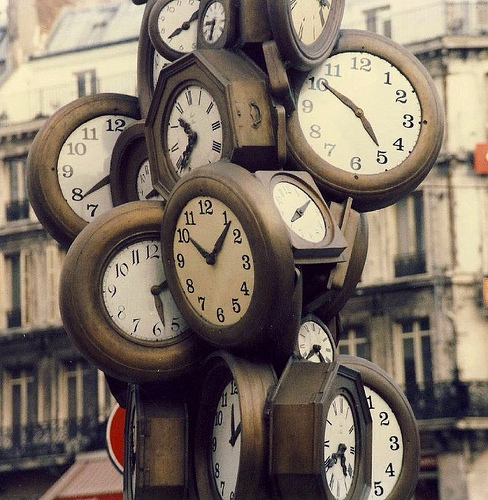
Are you (or someone you love) always late?
I don’t just mean running 10 minutes late for a meeting, I mean persistently late. For everything.
Late getting out of bed. Late getting into bed (sometimes to the point of never getting into bed). Late sitting down for dinner with your family. Late leaving the office, putting down the video game controller, or getting the baby from her nap.
Or maybe you do okay in these areas. Maybe you’re exhausted by larger-than-life emotions that, while quickly forgotten after the fact, feel all-consuming in the moment.
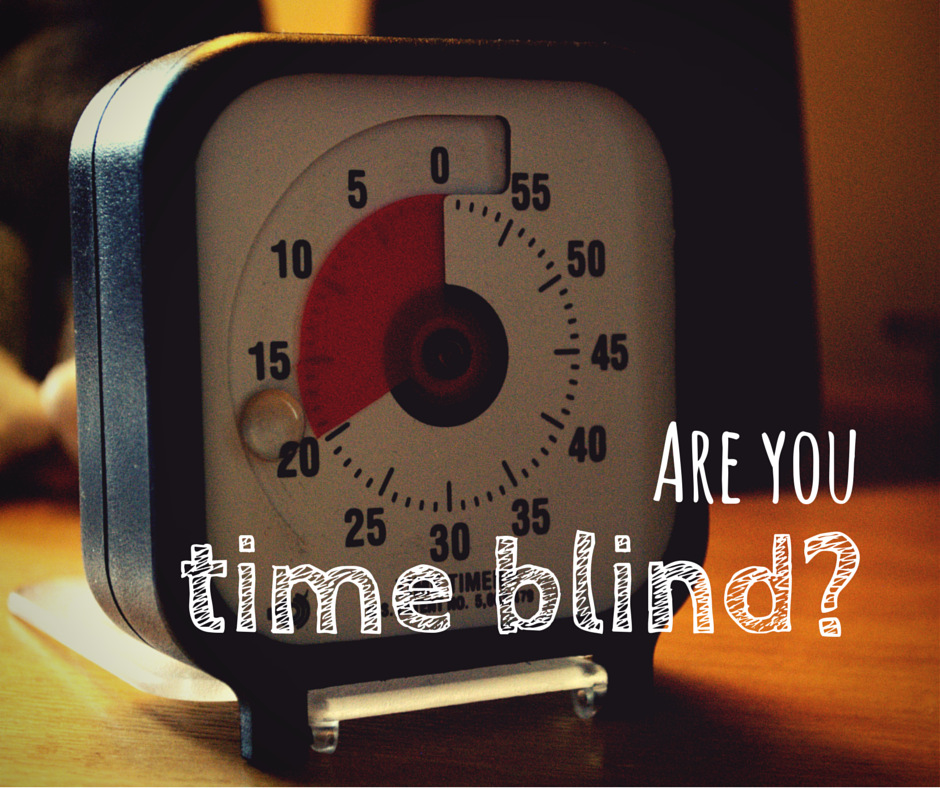
There’s a name for this: time blindness.
And while you might not believe me yet, there’s hope.
The truth about time blindness.
 Photo by nicksarebi
Time blindness isn’t just a matter of ‘feeling like’ time is moving quickly or slowly. It’s a failure to view time as linear, concrete, or even finite.
This means most traditional time management strategies won’t work for most ADHD’ers. It doesn’t mean we’re not responsible for how we manage and deal with our ADHD — including our distorted perception of time.
Learning to manage time is one of the best investments you can make in your relationship with yourself and others.
Time blindness & you.
Time blindness manifests differently in everyone, just like ADHD itself. In other words, it’s more complicated than “she always gets out the door late” or “he’s unreliable.”
After my first week on stimulant medication, I wrote the following revelation in my journal: “a week is only a week long.” Obvious? Hardly. I’d never perceived an emotional state, a rough day, or even being unbearably hungry as something with a beginning, a middle, and an end. If you suffer from wild, all-consuming emotions — positive or negative — training your brain to perceive time more accurately can provide significant relief.
Time blindness often causes time to ‘get away’ from people with ADHD. As one ADHD’er put it in an ADDitude discussion thread: ‘I have helpful friends who say, “just look at your watch and leave when it is 3:00 p.m.’ But when I look at my watch, it is 4:30 p.m.!”
For my husband, time blindness shows up in the form of marathon work days, late bedtimes, and plenty of household projects that he “didn’t intend to take all day.”
Time blindness can hurt. It can make those on the receiving end feel confused, disrespected, angry, unimportant, and betrayed. But before you lash out at someone who has broken a social contract (again) by mismanaging their time, remember: it’s not about you. It doesn’t reflect on how important the obligation actually was to them. When a loved one says, “I have no idea why I keep doing this,” they’re telling the truth. They feel every bit as let down as you do.
The only answer is education (for all parties involved), forgiveness, and a lot of patience and compassion.
Finding information and advice.
I’m pleased to have found — and to be able to share with you — this free podcast with Dr. Ari Tuckman, author of More Attention, Less Deficit and Understand Your Brain, Get More Done. Dr. Tuckman is approachable and to the point, giving some much-needed information and advice about one of ADHD’s more confounding facets.
Don’t skip the listener comments and questions, either. I found their stories of success and defeat very therapeutic and I suspect many others will, too.
Before you run off and listen to the podcast, here’s a tip from our home to yours: do everything you can to represent time visually. My husband insists he actually reads analog clocks more quickly and easily than digital, and that’s not surprising. Analog clocks quantify time — especially for visually-oriented people — in a way digital cannot.
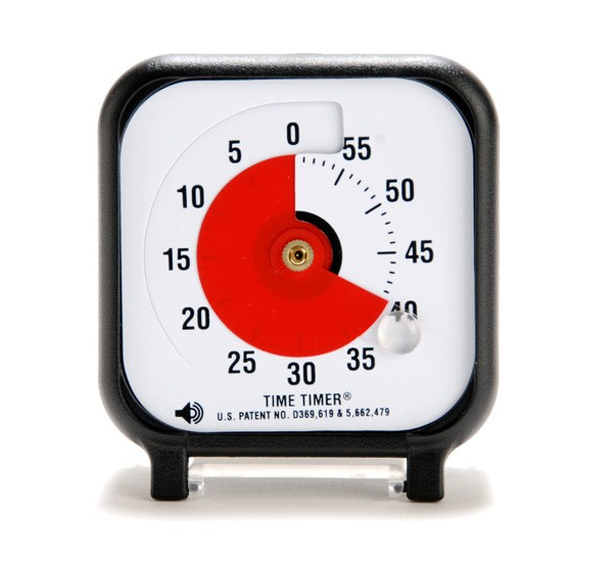
Likewise, timer apps like Ovo Timer (free, Android-only) or Time Timer ($0.99 Android, $2.99 iOS) start with a chunk of color that gradually disappears. You can also buy standalone Time Timer clocks to keep around the house.
I’m already teaching my two-year-old about time with the Time Timer when we clean up his toys at night. We don’t talk much about numbers, but he understands that when the red wedge disappears, he’s supposed to be ready to move on to the next task.
Do you struggle with lateness or with time ‘getting away from you?’ What are some strategies you’ve tried?
Hey there! Are you enjoying The ADHD Homestead?
Here's the thing: I don't like ads. I don't want to sell your attention to an advertising service run by the world's biggest data mining company. I also value my integrity and my readers' trust above all, which means I accept very few sponsorships/partnerships.
So I'm asking for your support directly. For the cost of one cup of coffee, you can help keep this site unbiased and ad-free.
Below you will find two buttons. The first lets you join our crew of Patreon pals and pledge monthly support for my work. Patrons also have access to my Audioblogs podcast. The second takes you to a simple donation page to pledge one-time or recurring support for The ADHD Homestead, no frills, no strings. Do whichever feels best for you!

Wow! I have time blindness. I had no idea it was a thing. It makes a lot of sense. I have worked hard to figure out ways to cope with time blindness and am getting better at being on time. I realise I need a lot of time where I don’t have anything scheduled or planned so I can cope with the times there is a lot more pressure on me. My anxiety is too severe and I get too worn out by having to constantly cope with outside pressures on me. I need uninterrupted down time to lose track of time as a rest period. I cope a lot better with time management when I have these times regularly.
I’m so glad you said that! I think I self-medicate by packing my schedule and over-structuring my life. It had never occurred to me how therapeutic the right kind of break can be: letting myself get wrapped up in a project in the basement, going for a walk, reading a book without setting a timer to make sure I don’t read for too long, etc.
It’s hard for me to do these things without feeling uncomfortable, cranky, or out of control, but you’re right, learning to rest is a necessary skill.
I am really good at being on time. I build oodles of extra time into my schedule so that I am actually early. I think this comes from my history as a late person. It upset so many people I had to find a way to get it under control. Being late caused me to miss so much!
Stress over the potential of being late probably accounts for 95% of my on-time arrivals anywhere (the other 5% is times when I’m actually just organized, or I misread my calendar and thought we were meeting earlier…)
Growing up, my dad was super strict about being on time, so I kind of developed a complex about it! I’ve found it tougher and tougher now that I’m in charge of my own household. Sometimes I feel like my guys are truly conspiring against me!
Oh I know my son is conspiring against me. He doesn’t even hide it!
and this is EXACTLY why I have an alarm for everything and set a timer whenever I need something to happen in a few minutes
Yeeaaah sometimes if I’m really nervous about messing something up I set three alarms to go off 15 mins apart 🙃
Oh I know that feel. I’ve done that before.
First I would like to state that time is not about being ‘blind’ or a negative issue. Time is a artificial construct brought about during the industrial revolution to ensure workers were there to work in the factories as the bosses wanted. So what we have is an artificial construct created by a western capitalistic system. So when we see this as a disability – perhaps we need to rethink our premise. In our society, it is an issue, however, in traditional societies it was not an issue . So how do I get my perceptions to work for me? In our society with a time based view of our world and our lives, it is obviously a major obstacle. This is why people from cultures that are not so time based struggle with our artificially rigid structure. We insist that children live in locked step constructs around time, age and behaviour. How healthy is his whole system and can we find ways to stop insisting that we all march to this hidden drum?
I have discovered that my ADD and lack of time awareness has opened up other boxes for me. I can adhere to certain time lines by setting up somethings as anchors in my day. However, when I have nothing that is outside my control to create this anchor my day just is. . . So I look at certain projects I want to get done and break them into agreeable chunks that will not be based on a specific timeline. I know that I want to move my sewing machine from the front room to a spot in my bedroom. As many people with ADD I live in clutter. So a couple of months ago, I began to clean a single corner in my bedroom so I could use my ZOOM connection without others seeing the clutter in the rest of the room. So now I have another corner to take care of and that is not about time but about a project that I want to complete before Monday and today is Saturday. Its still waiting. However, now I am going to do supper instead. This means it may be 2 am before before I move that sewing machine. However, it will be done before I sleep. That is all I care about today.
The rest of the day has drifted and I know I need to do that as the other things I have done are important too. I may be 78 but my friends are mostly in their 30s. So we folks with ADD have minds that do not stick to our ages. Our sense of time seems to also be connected with not being as conservative as our age mates. I am constantly involved with people with so many life experiences. I understand so well what it is to ‘not belong’ and so when we talk about life and issues they are dealing with – we are able to tear apart the systems that are keeping us stuck. So my friends are often doing post secondary education and are activists.
So your question must be – how does this last bit relate to the issue of time. Its based on our perception of time and how it is used as a tool of control and oppression by the status quo. These days as well deal with the Pandemic and do so much more on line – I think we are beginning to see how time is not as relevant to our society as we thought it was.
Just found this caught in the spam filter — my apologies! But thank you for these comments.
My take on the time issue is, we all have different needs and expectations. There are certainly cases where we could do to change our perspective. But then there are cases where our time perception can cause harm to us or to loved ones.
I remember how it felt to be the last kid standing around waiting to be picked up from an after-school activity. I also know how it feels to be an adult sitting in a restaurant, having wine and appetizers alone, with our reservation time over thirty minutes past with my date nowhere in sight. Even just around the house on a typical Saturday: sometimes we promise to help someone, or fix something that’s broken, or clean up a mess we made. Then we get caught up in a time warp doing something else and before we know it, the day is gone.
Of course those of us with ADHD understand. We know it’s not intentional. We realize a certain level of compassion and forgiveness is required. But it’s also natural to feel hurt and unsupported if these things happen regularly. Plus, many of us want to feel like we have a choice, like we are spending our time intentionally. Sometimes that whole Saturday in the time warp is spent doing something we would not have chosen over other priorities (including fulfilling creative projects, etc., not just chores around the house).
And then there is the emotional side of time blindness. ADHDers are at an increased risk for self-harm. Many of us have big feelings that can be very overwhelming in the moment. Our current feelings, we feel 100%, and can’t imagine feeling differently. Sometimes this is charming, but other times it can feel very out of control and frightening.
It very much depends on the person and the situation. My husband, for example, has no such issues with emotional hyperfocus/time blindness. My son has inherited my big feelings. For some, time blindness feels like it’s keeping them from doing what they want to do — for others, it doesn’t feel like such a hinderance.
I no longer have a job with rigid hours/structure, but even so, I have to say I like to choose how my time is spent. Even if clock time did not exist at all, my time perception would (and does) affect my mental health and creative work, and I’ve found it incredibly helpful to learn more about how my brain perceives time.
This isn’t actually true. Time in how we measure it is an abstract concept but time in the passing of things is just a fact of reality. The idea that being on time only began to matter in capitalist modern society is nonsense. Pretty much every empire and kingdom throughout history had ways of keeping time as appointments were still important and people needed to know when to meet up for things. Being on time was also very important whether it was for war meetings, art or philosophy classes or otherwise. It was also not at all a western thing either and honestly it appears you are very much misinformed.
The Sumerians where the ones who devised the use of 60 in time telling. Twelve was important to Sumerians and Egyptians, 12 lunar cycles and the number of constellations of the Zodiac. Day and night then got divided into 12 periods and that was the start of the 24 hour long day.
Babylonians who existed before the 18th century…B.C. invented the degree and defined a circle as having 360 degrees as they understood a year to having close to 360 days hence the sun would move along it roughly 1 degree per day. Eratosthenes discovered the world was round by taking the shadow from two points and working out the math to prove that the angle of the shadows meant the world was round and was pretty damn close to the correct circumference of the earth in his conclusion so he “adapted degrees to quantify lines of longitude and latitude. Two centuries later in the Roman Empire, Ptolemy of Alexandria subdivided degree coordinates into 60ths (minutes) and 60ths of 60ths (seconds).” This form is still used today.
People throughout history still had to keep time and people with ADHD or time blindness would have still been late or waking up well past dawn, going to bed way past dusk and so forth regardless of how primitive, advanced or basic their time keeping system may have been wherever they were in the world. In traditional society it very much WAS an issue. If you’re supposed to be attacking a neighbouring tribe or defending your own or need to head out hunting for the day and you don’t show up on time, even if everything works out for the others, they would have been pissed! You’d risk being ostracised from the group if you did it in certain circumstances or with regular frequency. In wars, when people needed arrows made or armour or weapons, swords, spears, shields, they needed them done in a specific time frame. Time has always mattered for humans, one way or another. It’s not western or capitalist or modern.
You are not noticing how people talk about various groups seeing time as flexible? Those cultures who would walk long distances to meet one another. Your assumptions that they would be expected to be on time has another side. When enough people show up the hunt would begin or the battle. I have been greeted with ” you came” with a smile. Others arrive when they are able. The meeting or service begins as enough of us arrive and we finish when the work is done.
This has always been my gut reaction, too. Even if clocks didn’t exist, I would still want to have perspective on my emotions so they didn’t feel all-consuming and scary. Even if clocks didn’t exist, I would want others to feel like I loved and supported them. I’d want to feel I had choices over my behavior and the capacity to give as much as I receive from others. Folks who think it’s just about ~productivity~ or western concepts of time are usually missing the more important point.