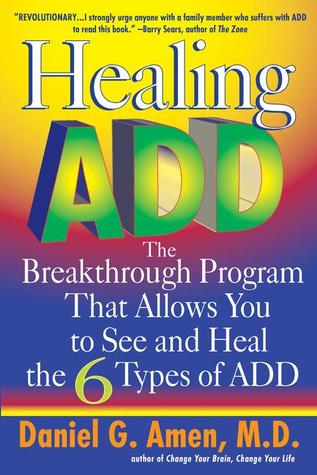
 Psychiatrist Daniel Amen’s work is controversial, to say the least. While Healing ADD from the Inside Out has some good information, readers should also be aware of criticisms from the scientific community.
That said, Dr. Amen provides a valuable perspective on ADHD, coming from a brain science angle that many will find appealing. As his patient anecdotes illustrate, people often open up to treatment after seeing their behavior’s biological roots.
That may be the book’s most important takeaway: ADHD isn’t a personal failure, it’s a measurable neurological condition.
Common-sense advice for managing ADHD
Readers will also find plenty of common-sense advice. For example: avoid hitting your head and damaging your brain, stay hydrated, eat a healthy diet, and limit TV and video games.
What Amen has to say about head injuries — even minor, forgettable ones — may shock you. Amen Clinics’ doctors ask new patients five times about previous head injuries, even minor ones where the patient never lost consciousness. The degree to which your behavior and personality can change as a result of a bump on the head is startling, and certainly makes me glad I wear a helmet when I ski.
My biggest criticism of Dr. Amen’s lifestyle advice is its severity. He recommends some pretty radical diet changes — for example, eliminating sugar and bread. Don’t get me wrong, I agree refined sugar is terrible for you, but strict elimination diets feel out of reach for a lot of people. I’ve benefited from drastically reducing refined sugar and switching in whole grains whenever possible. Dr. Amen overlooks the benefits of eating brown rice and whole grain breads and pastas for those who aren’t willing to give them up entirely.
Though Dr. Amen’s five ADHD subtypes haven’t been adopted by the scientific community, I found them useful to illustrate the point that every ADHD case — and every treatment plan — is different. Managing ADHD symptoms takes some finesse, not just a quick evaluation and a prescription for stimulants.
SPECT imaging and supplements: buyer beware
Beware, though: Healing ADD focuses heavily on the Amen Clinics’ treatment and diagnostic methods, which cannot be replicated at home or at your local doctor’s office. After reading Healing ADD, it’s easy to convince yourself you’re at the mercy of your brain until you get one of these SPECT imaging scans — especially if you’ve been frustrated by past treatment failures.
However, the Amen Clinics are alone in their use of SPECT imaging in routine diagnosis, and most of the scientific community feels there’s a good reason for that. Bottom line: you don’t need to travel to one of these clinics and pay over $3000 to get better.
Parts of the book also felt more like an advertisement for the Amen Clinics’ products and services than a standalone self-help text. The techniques and advice seem broad and cursory, like Healing ADD is only an introduction to the whole system: DVDs, supplements, an online brain gym, and consultation at a brick-and-mortar Amen Clinic.
Comprehensive but not warm and fuzzy
Healing ADD may pack a lot of advice and brain science, but it won’t feel warm and personable. If you want that, read Wes Crenshaw’s I Always Want to be Where I’m Not. Dr. Amen kicks off Part One by trying to build rapport with readers and prove he truly understands ADHD on a personal level, but he does it by talking about how guilty and embarrassed his ADHD family members make him feel. Maybe this rings true for some readers, but I didn’t need any reminders.
Overall, Healing ADD is worth a read for many people, especially those who doubt ADHD’s biological roots or have complex cases not aided by typical treatment approaches. The book inspired me to try a daily GABA supplement, and I do think it has helped tone down my migraines and mood issues. Certainly it’s a great starter resource for those interested in alternative or complementary therapies.
If you’re looking for in-depth techniques and help for any single facet of ADHD, though, Dr. Amen covers way too much ground for that. For example, the chapter on stopping “automatic negative thoughts” offers a gold mine of easier-said-than-done advice. If you’re truly struggling with these harmful thought patterns, you’ll need to seek professional help.
And that’s okay. Healing ADD provides, at the very least, a comprehensive guide to what you should expect to hear from a therapist or coach (minus the need for SPECT imaging). There’s plenty of bad information out there, and Dr. Amen goes a long way to cultivate educated consumers in his readers.
Hey there! Are you enjoying The ADHD Homestead?
Here's the thing: I don't like ads. I don't want to sell your attention to an advertising service run by the world's biggest data mining company. I also value my integrity and my readers' trust above all, which means I accept very few sponsorships/partnerships.
So I'm asking for your support directly. For the cost of one cup of coffee, you can help keep this site unbiased and ad-free.
Below you will find two buttons. The first lets you join our crew of Patreon pals and pledge monthly support for my work. Patrons also have access to my Audioblogs podcast. The second takes you to a simple donation page to pledge one-time or recurring support for The ADHD Homestead, no frills, no strings. Do whichever feels best for you!

I read this book recently. I was having trouble writing a review of it. Like you, I liked the common sense advice and patient profiles. But I felt like it left a strange taste in my mouth – I couldn’t take it too seriously. I am glad you did the review, it was very impartial. 🙂
Thank you! I agree, it was kind of tough. There’s good information in there, but I suspect many people would be tempted to buy the whole thing hook, line, and sinker — not the best idea. I’m glad your instincts tipped you off!
At the same time, many people n the internet would prefer to discredit Dr. Amen entirely, and I think we lose something in that approach as well.
How To Find The Right Spell Casters
We are the real spell casters who provides really overwhelming results! but they can be found with some help from the community.
As When you are very good at what you do, We do not just broadcast on social media and the world that you can do love spells for any relationship. Your Inbox would be flooded for help. Spell casters that are real want to help the people that genuinely and truly wanting their help. The rituals and manifestations they do are sacred.
http://spellcastershelp.co
EMAIL: verifiedspellcasters@yahoo.com
WATSAP: +27739609999
I came across another blog that was critical of Dr. Amen’s book and his utilization of SPECT. The most telling thing is the links that are shared at the end of the post, relating to a few insurance company’s policies on not covering use of SPECT for ADHD/ADD due to a lack of peer reviewed literature to support its efficacy for this purpose. https://www.quackwatch.org/06ResearchProjects/amen_response.html
One thing I did find encouraging is that I took the survey on Dr. Amen’s website and it actually told me that I “may not have ADD”, which at least tells me that his efforts are sincere. I know I have something going on that makes it difficult for me to stay on task, etc. if it’s not ADD, great, I want to know that…but I also want to figure out what’s going on.
Yeah, despite the beefs I’ve listed I do think Dr. Amen’s work is a definite net gain for the ADHD world. When I wrote this review I hadn’t spent quite so many years slogging through the morass of literature from so-called experts trumpeting ADHD’s “gifts.” Dr. Amen is very knowledgable and straightforward about not only ADHD’s impairments, but their roots in our brains. Good stuff, and there’s information I’ve read in this book that I haven’t seen articulated so well anywhere else.
That said, I wouldn’t want anyone to read his work and feel like these expensive scans and assessments — not to mention the supplements — were their only hope.
I hope you figure things out! It can be incredibly frustrating, as progress often depends on the very skills that are most impaired.
As a personal aside, I was baffled when a friend started describing struggles with what sounded like textbook ADHD — except the symptoms had come out of nowhere in adulthood. Turned out she had an undiagnosed thyroid issue which, incidentally, is something my own doctor checks for before prescribing anyone meds for ADHD.
That is to say, many other issues can create ADHD-like symptoms. Good luck to you!