If you love someone with ADHD, you may know too well how blame shifting hurts a relationship.
There are many ways to shift the blame:
“If you didn’t make me so angry all the time, I wouldn’t explode at you. Would you rather I bottled it all up?”
“I wouldn’t have gotten a speeding ticket if you hadn’t asked a bunch of questions when you knew I was trying to get out the door.”
“I never thought I’d be the type to cheat, but you made me feel so unappreciated.”
“You and Dad never modeled a healthy relationship for me. No wonder my marriage fell apart.”
For the purposes of this post, let’s look at a smaller-scale example:
Suppose you’re having company over tonight. Your husband1 meant to take pork chops out of the freezer last night, but he forgot. He arrives home from some errands at 4:30, ready to marinate the chops so he can throw them on the grill when your guests arrive.
Upon discovering the meat still in the freezer, he blows up at you:
“Great! Now dinner is ruined! You were here all day and you couldn’t have noticed the meat wasn’t in the fridge? Every time I think you have my back, you’re just thinking about your own stuff and doing your own thing. All our other married friends work together as a team. You make me feel like our relationship is just every man for himself…”
And on and on.
First thing’s first: blame shifting is abusive behavior
In describing this behavior to your friends — or searching the internet — you may hear people call it psychological abuse. But does this mean you’re in an abusive relationship and you need to leave?
Maybe — but it’s rarely that simple.
Unmanaged ADHD can absolutely lead to abusive behavior. Willingness to acknowledge, learn about, and treat it can make or break an intimate relationship. But while an ADHD diagnosis can explain a lot of relationship problems and help us identify solutions, it doesn’t give us license to mistreat others. No one should accept continued abuse from an ADHD partner who refuses to take responsibility.
At the same time, learning about ADHD can start us on the path to becoming our best selves. Within my own family, I’ve seen people undergo change I never imagined possible, making amends for past harm and forging stronger, more emotionally safe connections with loved ones.
Labeling someone an abuser and severing ties often feels no less wrong than continuing the status quo. And some people, especially minors living with a volatile parent, don’t feel like they have the option to “just leave.”
I wrote this post at the request of someone who neither wanted to abandon their loved one nor considered such a move warranted or appropriate. Yet they wanted to know: why does this happen? How can I defuse the situation instead of fanning the flames? How can I set boundaries to protect my own mental health? That’s what I want to address here: the how, the why, and what we can do about it.
However, if you’re in an abusive relationship that feels emotionally unsafe2, please take immediate steps to find support and protect yourself. You’re not responsible for fixing or managing an abusive partner.
Why we blame others
It’s easier to blame someone else than it is to accept our own (often overwhelming) faults. It’s also easier to cast ourselves in the role of the victim when faced with a blame shifter. Once we’ve accepted that role, both parties learn to play their part like it’s second nature.
Before we write off a blame shifter as incurably abusive and ill-intentioned, we should take a closer look. The ability to see a situation from multiple angles and experience emotions without being blinded by them is a marker of strength. We can assert and protect ourselves in ways other than walking out the door.
As we seek that steady foundation, we need to remember why people tend to mistreat others. As a child, I remember my mother telling me other kids picked on me because they felt badly about themselves. Bullies of all ages use others to shift focus away from their own hurts.
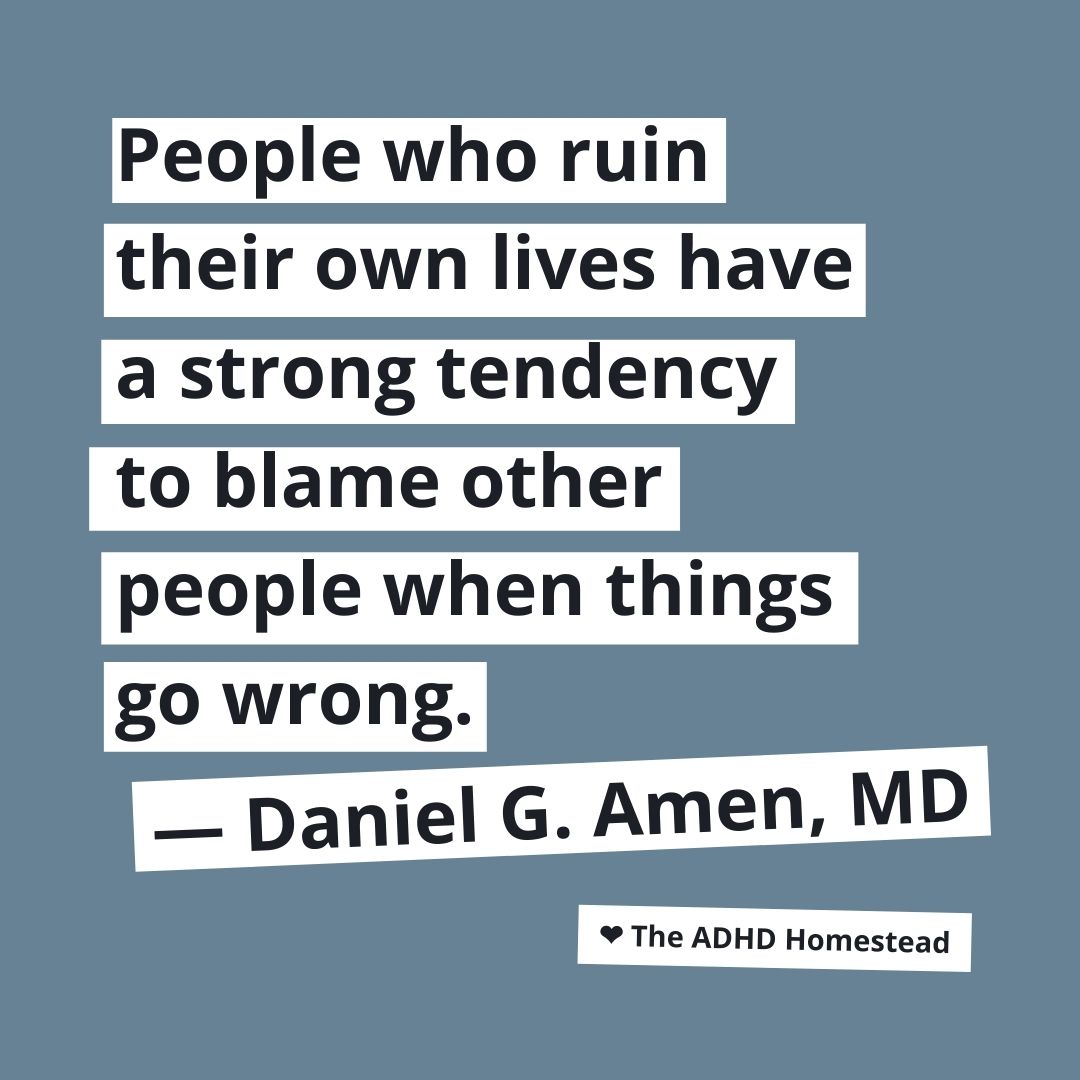
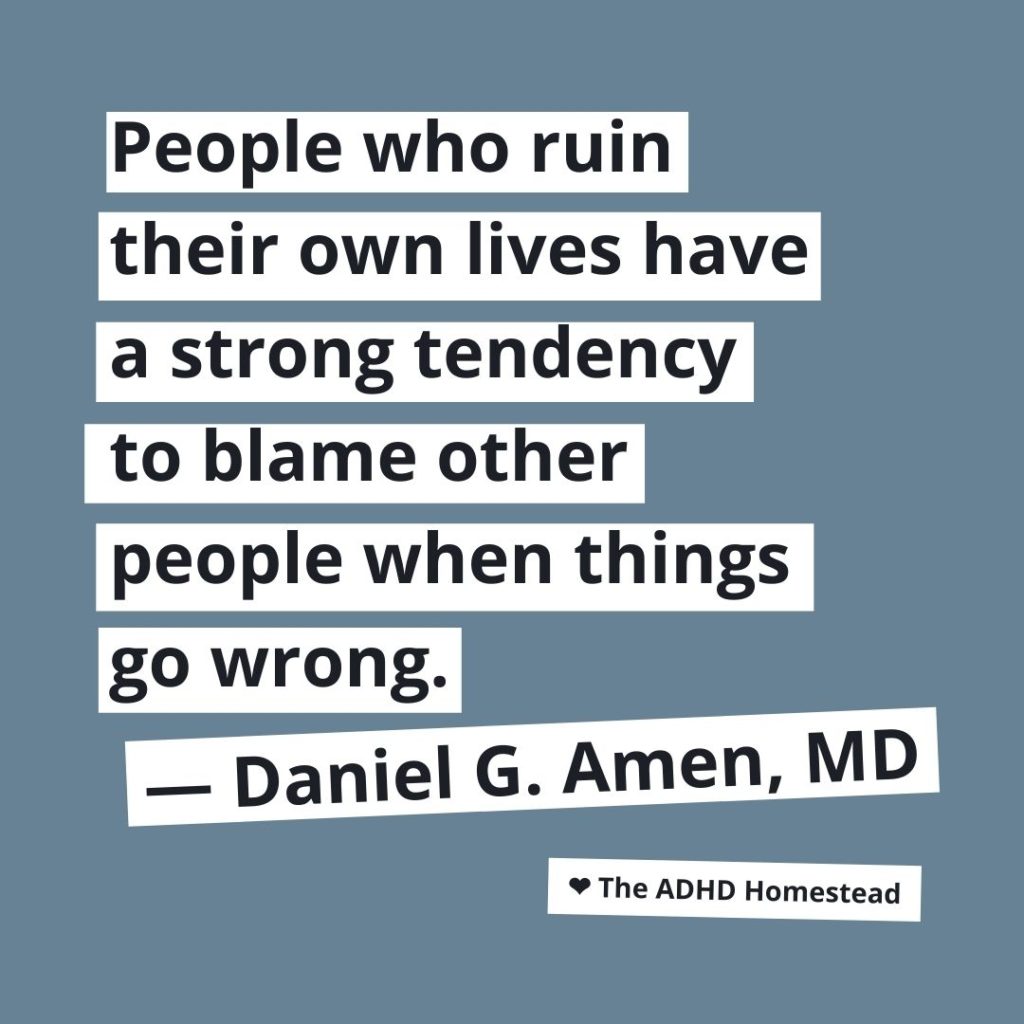
In his book Healing ADD from the Inside Out, Dr. Daniel Amen writes, “people who ruin their own lives have a strong tendency to blame other people when things go wrong.” Consider the pain, humiliation, and self-loathing weighing on the hearts of so many ADHD adults. It’s easy to see how blame shifting and other emotionally abusive behaviors become the path of least resistance.
Accepting even a minor failure — like forgetting to take the meat out of the freezer — can feel like too much to bear if ADHD has already decimated your self-image. If you allow yourself to own that one misstep, you open the floodgates. You confirm your worst fears about yourself and reinforce your most damaging self-criticisms.
Disarm with compassion and clarity
I’m not excusing bad behavior. I’m seeking explanations beyond “so-and-so is just a bad person.” When you’re feeling wounded by a blame shifter’s words, try to remember they’re hurting, too. This knowledge may make it easier to begin from a strong and productive place rather than simply retreating or attacking back.
And it does take strength. The best first step in a conflict is to acknowledge your own contribution, even if the other person is wrong.
Why? Because this removes the blame shifter’s weapon. You cannot assume a position of strength without making yourself vulnerable. When someone shifts the blame, that’s a good signal that they’re coming from a place of weakness. They will redouble their attacks if you begin by focusing on their faults.
When acknowledging your contribution, don’t dwell on blame or get melodramatic. The idea is to communicate to the other person, “I’m not interested in discussing who’s to blame here” and move on.
In the case of the frozen meat, that means saying, “I’m sorry I didn’t notice when I went into the fridge to get my lunch. If I had, we may have been able to get the meat thawed in time.”
You may fear you’re just rewarding bad behavior. There’s inherent risk in making yourself vulnerable. But consider your options. If you argue, deny, and try to pass the buck back to the blame shifter, you’ll make him feel even more threatened and prone to attack. You could slink away, refuse to engage, and wait for it to blow over, but that makes you an ideal target: a person who won’t stand up for yourself. A person who will allow someone to tear you down to make themselves feel better. That’s not okay.
Be firm and kind, and check your emotions
After accepting your contribution, be firm. Don’t enable blame shifting now or in the future. Help the blame shifter see their role in the situation by making clear, non-threatening observations about what happened.
Avoid statements that aren’t about you: “you said you’d be in charge of the meat. I shouldn’t have needed to worry about it.”
Instead, describe only your own feelings, observations, and interpretations: “the meat wasn’t on my radar. I guess I kind of forgot about it after we decided you’d grill and I’d make the side dishes. It sounds like you’d like for us to check on each other a little more intentionally to make sure nothing gets forgotten.”
This shifts focus away from finger-pointing and toward problem solving.
If the blame shifter continues to dump on you, speak up. Resist the urge to get emotional or confrontational. For example: “I feel like I’m trying to look at this from both sides. It’s not okay with me to just focus on how I messed up because that’s not what I feel really happened here. Am I making it difficult for you to have a two-sided conversation about this?”
Once a blame shifter learns you won’t take the bait and feed the flames with more emotion, they’ll stop seeing you as a viable container for their own bad feelings and low self-esteem.
You can’t do it all
Sometimes a loved one will continue behaving badly, especially if their ADHD is untreated or poorly managed. Only you can know — through experience, soul searching, and repeated attempts to open doors to effective communication — if it’s time to remove yourself from a toxic environment.
Remember there’s hurt on both sides. Rarely does responsibility for stopping the cycle rest with just one person.
Much of the advice in this post was gleaned from Douglas Stone, Bruce Patton, and Sheila Heen’s Difficult Conversations: How to Discuss What Matters Most. If you’re dealing with a poor communicator, the best thing you can do to make things better is hone your own skills and lead by example. I highly recommend Difficult Conversations as a starting point for anyone seeking to heal a damaged relationship.
Have you felt victimized by a blame shifter? What did you do? Are you a recovering blame shifter? I’d love to hear your story in the comments.
Editor’s note: this post was updated to add a section on emotional abuse, an updated image, and narration on October 14, 2020.
Footnotes:
1: Though this example is gendered for clarity and flow, people of all genders can be victims of abuse, just like people of all genders can perpetrate abuse.
2: By “emotionally unsafe,” I mean: do you always feel anxious and emotionally exhausted, either from fearing when your partner’s next outburst will come or from trying to avoid provoking them? Since being with your partner, have you become more isolated? Less capable and sure of yourself? More anxious and depressed? Do you now struggle to trust your own perception and instincts? These are huge red flags for psychological abuse. Regardless of your partner’s own mental-health reasons for treating you this way, take care of yourself first.
Hey there! Are you enjoying The ADHD Homestead?
Here's the thing: I don't like ads. I don't want to sell your attention to an advertising service run by the world's biggest data mining company. I also value my integrity and my readers' trust above all, which means I accept very few sponsorships/partnerships.
So I'm asking for your support directly. For the cost of one cup of coffee, you can help keep this site unbiased and ad-free.
Below you will find two buttons. The first lets you join our crew of Patreon pals and pledge monthly support for my work. Patrons also have access to my Audioblogs podcast. The second takes you to a simple donation page to pledge one-time or recurring support for The ADHD Homestead, no frills, no strings. Do whichever feels best for you!

Nice job!
Thank you! 🙂 Been turning this over in my head for a while.
Are ADHDers more likely to blame-shift than non-ADHDers? It seems plausible, since many ADHDers feel insecure about their executive shortcomings, have a low tolerance for others’ “chaos”, and tend to seek confrontation. But I think it’s important to note that blame-shifting is far from limited to ADHDers. It’s ubiquitous. I think that’s because the urge to blame-shift is firmly rooted in our cognitive biases. A few examples:
Fundamental attribution error: “The tendency for people to over-emphasize personality-based explanations for behaviors observed in others while under-emphasizing the role and power of situational influences on the same behavior” (e.g., we assume the guy tailgating us is unequivocally a jerk, never that he’s rushing to meet a dying relative in an ER.)
Illusory superiority: “Overestimating one’s desirable qualities, and underestimating undesirable qualities, relative to other people”
Self-serving bias: “The tendency to claim more responsibility for successes than failures”
I think everyone, regardless of our brain chemistry, shifts the blame at some point in our lives. While blame-shifting doesn’t necessarily indicate ADHD, ADHD does make a person more prone to the behavior. I’d also hazard a guess that cognitive biases are a bigger problem for ADHD’ers than for those naturally blessed with excellent executive functioning.
Yes, I deal with blame shifting constantly with my 18 year old son who has ADD. I think it’s much more prevalent with those who suffer from ADD. If he runs a red light and my husband yells, “stop”, it’s my husbands fault for yelling. It’s more automatic and knee jerk than with neurotypical people. He experiences so much shame from feeling inadequate that the blame shifting is fast and violent. Thanks for the article because we constantly need to be reminded that the root of his behavior is not irresponsibilty or lack of character but pain.
Sorry for my late reply, I’ve been off the grid for a little while 🙂
Thank you for this comment. The “not lack of character…but pain” sentiment is especially important. We have some yellers in my (extended) family. It’s easy to feel hurt and demoralized when someone attacks you verbally. Remembering that it’s more about them than you — and that it’s probably happening because some part of themselves feels too painful to accept — helps so much.
My aunt blame shifts all of the time. She did that with me in my mid 20s and her around 50, but I started being around her again at 36 and her 60. An early example of her blame shifting, she bought a $12 Weedeater Electalite electric Weedeater when I was around 26. Her yard was growed up with foot tall grass and she decided to weed eat foot tall grass by her front door. She cut down about 3 square feet of grass and handed me her Weedeater, but she was totally unaware of the burning plastic smell. I want to say I tried to tell her that it was overheated, but I can’t remember because it was 17 years ago, this year. It burned up within 3 seconds and quit working. She tends to get easily frustrated a and snaps on me if I try to explain a situation to her. Then she blames me for her telling me to do something after I tried to explain to her why I don’t need to do it. I just burned her Weedeater up “for no reason whatsoever”. She’s decided I’ve had high functioning autism because of her mental issues. Her abusive mother that acted just like her blame shifting always decided I had mental problem, but could never see it was due to her own behavior. Ironically they could see each other’s behavior, but not their own. My aunt acts like a slave driver, but she doesn’t see it. My grandmother was always talking about my aunt’s behavior and would still ask “she still running you to death” before she passed on last year. Neither one of them could/can take responsibility for their actions. It’s always someone else’s fault. The latest thing is with my aunt’s prioritization issues, but that’s always been a problem. She used to drag up things to her house from flea markets before deciding we needed to get into the cattle business. I told her she was out of room in 2016, but her response a few years later was to blame me for her clutter problem. She has so much at her main house that she bought a lakefront property to escape to. She told me I “wasn’t going to junk out it’s living room out like the one at her other house”. She was also trying to buy a 3rd property near her main property for us to live in until we organized the clutter, but luckily she hasn’t been able to buy another property to drag things up and blame me. She doesn’t understand that people that want things are usually more involved in their organization. She expects other people to do her responsibilities and then is unhappy with them because they can’t properly do the other tasks that they’re supposed to do for her. After 4 years of overwhelming me, she decided to get into the cattle business. Expects me to be a professional and handle it all for her. I quit eating beef Jan.3, 2021, the first time she bought cow’s because the 3 “pretty little babies” sprayed diarrhea all over her small Mazda 3 car and she thought it was funny. I was disgusted and gave up beef from my diet that day because I knew what I would go through. She spent the whole month of January working at her nursing job to build up her money to pour money into cows, but we don’t have indoor plumbing because she quit having me splice it in 2020. I haven’t eaten beef in 2 years of Jan. 3, 2023, but she hasn’t even figured it out and I’m glad because I don’t want her angry at me because of her impulsive behavior. I was unable to wash clothes or get bath, but I don’t expect people that work about 16 hours a day, 7 days a week to go to the washateria to wash my clothes. She thrives on others being considerate of her, but she can’t be considerate of them. I pretty much had to worry about keeping the cow crap covered clothes on the outermost layer because I get cold easily and it was Jan. I managed to order a washboard to hand wash my clothes. Then she complains on her yard that she still hasn’t bought a mover for and I ended up ordering a manual reel mower to cut the grass. She doesn’t understand that people don’t multitask to the point of wearing their help out by expecting them to have the ability to do what 5 or more people can do. Now she complains about memory problems and is afraid of it being dementia. She’s had trouble keeping up with things all of her life. “Where are my keys” isn’t an issue for her. She just leaves them in the ignition of her vehicle, raising the chances of theft. Then she treats me like a personal digital assistant trying to remember her hundreds of things at once. I believe she has oppositional defiant disorder like her mother, but luckily she hasn’t been physically abusive to me like her mother. I’ve seen her win her share of fights though. I’m currently in mental health counseling due to the years of being raised by her own mother and dealing with her own behavior. I know she has ADHD, but I’m too unintelligent to tell her that. She has to scapegoat and blame me because she can’t take responsibility. Just like her mother that gave me anxiety and PTSD. I had to be a people pleaser just to cut down on receiving her own mother’s abuse and she can’t see that she uses my mental health problems, ingrained into me by her mother, that she uses to her advantage. She’s always liking to get her way like her mother. I know she believes her ideas and plans are that good so people should just agree. She doesn’t understand people people perceive that as being controlling and wanting to get her way. I have to partake in her interest and she has to even make plans for me for things I like with no input from me. She thinks everything is great because we don’t have arguments. I bite me tongue and walk on eggshells because she can act childish like her abusive mother. Her current childish behavior was she excitedly bought concert tickets for some little Rock concert in Mississippi. I declined because I told her I would rather have mental health counseling. The counseling she claimed to be concerned about 7 years, but her interests were more important. There was a few seconds of silence and then she replied in a five year old voice about I don’t like her concerts (that she essentially pushes on me and ignores my interests). We got off of the phone, but my hands shook for 20 minutes and I had a high heart rate. I live with severe depression all of the time and she doesn’t understand why. The way she carries on about Rock singer Chris Cornell’s depression and suicide, but she never truly see’s my pain and depression that she contributes to.