Recently, I received a reader email asking about supplements and natural remedies for ADHD.
My short answer: buyer beware.
People have many reasons to try supplements: older adults may have concerns about taking stimulants with heart problems. Parents may yearn for an alternative to stimulant medications for their children.
Maybe supplements just feel more “natural.”
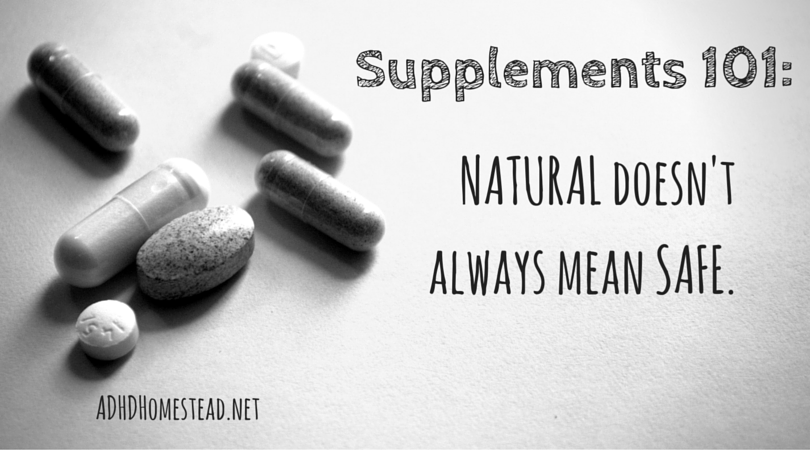
Natural they may be, but supplements aren’t necessarily safer or healthier than prescription drugs. Some may even be less safe.
Supplements: safety not guaranteed
The FDA treats drugs and supplements very differently. From aspirin to amoxicillin, medicines are vetted before hitting the market. Manufacturers must prove their drugs are not only safe, but effective for the conditions they claim to treat.
Compare that to the FDA’s treatment of supplements:
Although FDA has oversight of the dietary supplement industry, it is the supplement manufacturers and distributors that are responsible for making sure their products are safe before they’re marketed…FDA does not review supplements for effectiveness (as it does for prescription and OTC medications) before they enter the market. If the dietary supplement contains a new dietary ingredient, the manufacturer must submit for FDA’s review data on that ingredient’s safety—but not its effectiveness.
Vetting is up to the manufacturer, who profits from selling these products. But that’s okay because it’s natural, right?
Wrong.
“Natural” doesn’t always mean “safe.” Remember: arsenic, cyanide, and lead are natural substances, too. Consumers often mix and match supplements, unaware of how those substances will affect their unique body chemistry.
Getting too much of anything, even an essential nutrient, can harm your body. Some supplements will even alter the effectiveness of other medications.
If you’d like to learn more, the FDA provides a Dietary Supplements 101 overview on their website. NIH also offers guidance on using supplements wisely.
Big Pharma isn’t the only agenda in town
For all the conspiracy theories about “Big Pharma,” many consumers seem to trust supplement manufacturers implicitly. However, they’re also big businesses trying to make a profit. And they’re less accountable for the quality of what they sell.
We, as consumers, need to read everything with a skeptic’s eye. Where there’s money to be made, there’s often bias.
For example: I recommend Dr. Daniel Amen’s Healing ADD from the Inside Out to anyone interested in using supplements to help with ADHD. I also suggest reading with a grain of salt.
Dr. Amen is very knowledgeable and his book contains valuable insights. He’s also selling his own line of specialty supplements (among other things). It’s easy to read the literature and feel like the right combination of dietary supplements will solve all our problems.
Dr. Amen isn’t the only one to discover this niche. Sales of dietary supplements in the U.S. totaled over $30 billion last year. A savvy entrepreneur can put a line of supplements on the market quickly, without the research and development overhead of a drug manufacturer.
Are supplements a no go for ADHD?
Hop online or pick up Healing ADD and you’ll find plenty of anecdotal support for supplements. Maybe you’ll even discover they help ease your own symptoms. How we treat a chemical imbalance in our body is always up to us. I’ve written on this blog about my own experience taking a GABA supplement for migraines and mood swings.
However, we lack evidence that supplements can meet or exceed the effects of traditional ADHD medication for the average person. If something sounds too good to be true, it probably is.
As always, it’s important to look at where various messages are coming from, and who stands to profit from us believing what we read.
Have you tried supplements for ADHD? What was your experience?
Hey there! Are you enjoying The ADHD Homestead?
Here's the thing: I don't like ads. I don't want to sell your attention to an advertising service run by the world's biggest data mining company. I also value my integrity and my readers' trust above all, which means I accept very few sponsorships/partnerships.
So I'm asking for your support directly. For the cost of one cup of coffee, you can help keep this site unbiased and ad-free.
Below you will find two buttons. The first lets you join our crew of Patreon pals and pledge monthly support for my work. Patrons also have access to my Audioblogs podcast. The second takes you to a simple donation page to pledge one-time or recurring support for The ADHD Homestead, no frills, no strings. Do whichever feels best for you!

We do not met the criteria for this study so we can’t enrol, but they have been having some very promising results so far. http://www.psyc.canterbury.ac.nz/research/Mental_Health_and_Nutrition/Child%20ADHD%20Study.shtml
Interesting. I have a feeling we’ll be seeing a lot of research into this kind of thing in the future. From what we know now, genetics are the strongest predictor for ADHD, so diet and nutrition can only go so far to work with the hand we’re dealt.
However, even if people do choose prescription medications, I’m a big believer that correcting the underlying chemical imbalance is only the beginning of our journey. We should be looking at anything else that can support the process.
Hopefully, as people continue using supplements and more research is done, the FDA will begin treating them more in line with drugs, as opposed to food (which is what they do now). They are more than just special foods!
Well, this article was not what I had in mind.
I’ve used prescribed ritalin, but now I only use supplements. Not saying its better, but it can work too.
I think you missed a lot in this article
Thanks for your feedback, and I’m sorry if this post wasn’t what you expected. This is the second post I’ve written about supplements, and I could probably write several more and still not include everything there is.
I kept the focus of this post intentionally narrow: to make the point that just because a product is natural, doesn’t mean it’s better or safer. It’s a common enough misperception that I thought it needed to be addressed, especially given the anxieties people can have around taking stimulant medications.
I try to keep my posts short enough for people to read in one sitting, with the tradeoff being I can’t cover every angle in one post.
I certainly didn’t intend to say supplements can’t or don’t have benefits, just that they’re not regulated in the same way as mainstream drugs. I’d be curious to know what supplements you’ve tried, and how you compare the effects with a drug like Ritalin.
(Also curious to know if your experience was with the generic or the name brand, as I’ve found the generics pretty disappointing…but that’s another post!)
Yes, i totally agree! I enjoyed reading the article, I just tough it was a different type of article 🙂 The title is misleading, but probably is on purpose.
I took methylphenidate, later with propranolol or some other beta blocker. This was useful, but very violent to me. I think, at the pharmacy, it doesn’t matter if its generic or not. And I prefer generic methylphenidate than Ritalin (extended release) 😛
I also tried modafinil, looks very promising.
Now, I am trying suplments, as i think generally they are “safer” and cheaper.
Do you know about nootropics? Smart drugs? They are not classical drugs neither “natural herbs”. They can be very helpful for adhd and other conditions. Even perfectly healthy people 🙂
Given that the generics are all a little different, some people find a specific generic they like best — even more than the name brand. I had that experience years ago, then the pharmacies suddenly started carrying a different generic, and it didn’t work well for me.
You’re right, at the pharmacy, it doesn’t matter. For Ritalin, most will only stock one generic, no name brand. Drives me crazy, and once again, the lack of reasonable FDA regulation around it means there’s not much we can do to ensure we’re getting what we need. That is, unless you’re willing to pay extra and ask a pharmacy to special order the brand.
As I understand it, the term “nootropics” (aka smart drugs) has been around for quite a long time and includes the whole shebang of cognitive enhancers: supplements, caffeine, prescription stimulants, etc.
Yes, lack of regulation sucks…
Yes! They are very interesting. Some compounds have more utility than prescribed medication… Very interesting for adhd.
Nice talk! Thank you! Keep up