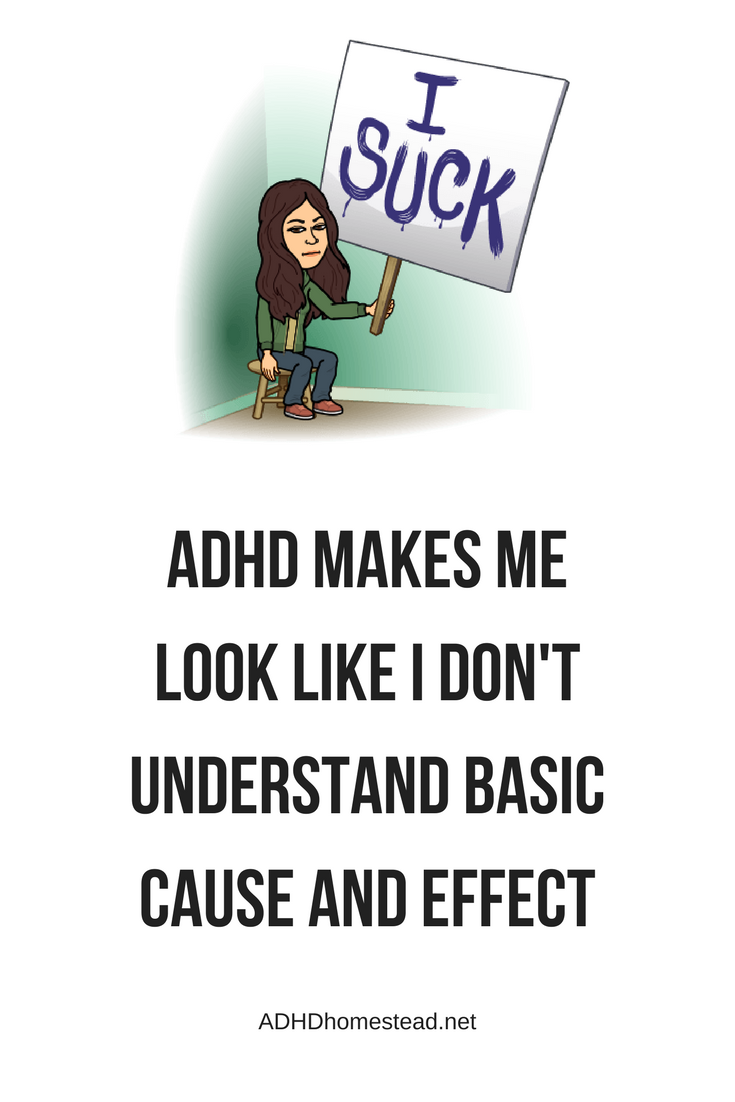
Sometimes — maybe more than sometimes — people with ADHD behave in ways that make no sense. Those living close to us wonder, how can we not understand? Spending money now = not having it later. Missing another deadline = getting fired from your job. Forgetting to put gas in the car = car not running. We learn these concepts as babies, when we invert our Cheerios bowl over the floor, or pull the cat’s tail, or cry when left alone in our crib. It’s basic cause and effect.
And yet, here we are, losing another job, paying another late fee, waiting for AAA to rescue us from the side of the road. Maybe you bite your tongue against words like stupid, childish, and irresponsible. You’ve been told they aren’t helpful. We still apply them to ourselves. Our actions make as little sense to us as they do to you.
 The dots don’t always connect
 The dots don’t always connect
In case I wasn’t clear: yes, I know my car will eventually run out of gas if I don’t refill the tank. But there’s a difference between possessing logical knowledge and feeling it, deep in your bones.
When I drove a lot, I made stopping for gas part of my regular routine. Now, I drive less. I rarely fill up more than once per month. By the time I need gas, I can’t remember the last time I did it. The action isn’t triggered until the orange light is on solid.
On the highway, when I have less to do, I will look down and remember the gas gauge exists. If it’s getting low, I’ll think, “I should get gas.” By the time I’m sitting at a red light and see a station, I’ve forgotten. “How much are they charging for gas?” I wonder. I note the price and keep driving, never returning to my previous train of thought about needing to purchase that gas for my car.
Even as the needle gets lower and I think about the gas station more often, the time never seems right. The station is on the wrong side of the street. I’m already running late. I’d rather do it tomorrow. And so on, until the orange light dangles the threat of public shame over my head and pushes me to action.
But why?
The culprit behind this — and many other ADHD frustrations — is the neurotransmitter dopamine. Many people refer to it as the chemical of pleasure and reward, but craving and desire hit closer to the mark. Consider this:
When researchers implant rats’ brains with electrodes to stimulate the reward system, the rats stop at nothing to keep the dopamine hits coming. Destroy this part of the brain, and your rat will still experience pleasure from a reward, but he won’t work to get it.
Sound like anyone you know?
With too little dopamine available in our brains, we can appreciate a positive experience, but we don’t crave it properly before we have it. Our logical brain knows we should want it, but the part that drives us to work for it is out to lunch.
ADHD also impairs working memory. The brain’s working memory holds onto information until we can act on it. A “leaky” working memory lets important pieces slip away before they reach long- or short-term storage. We sometimes find it impossible to hold more than one thing in mind at once.
For you nerds out there, working memory is like your computer’s RAM. For the rest of you, a shortage of RAM or working memory can render the whole system borderline unusable. You can’t retrieve or store long-term memories reliably, nor can you make effective decisions on what to do next.
Bad choices
In other words, there’s real neurochemical stuff happening here, folks. Stuff that affects the brain’s ability to function properly.
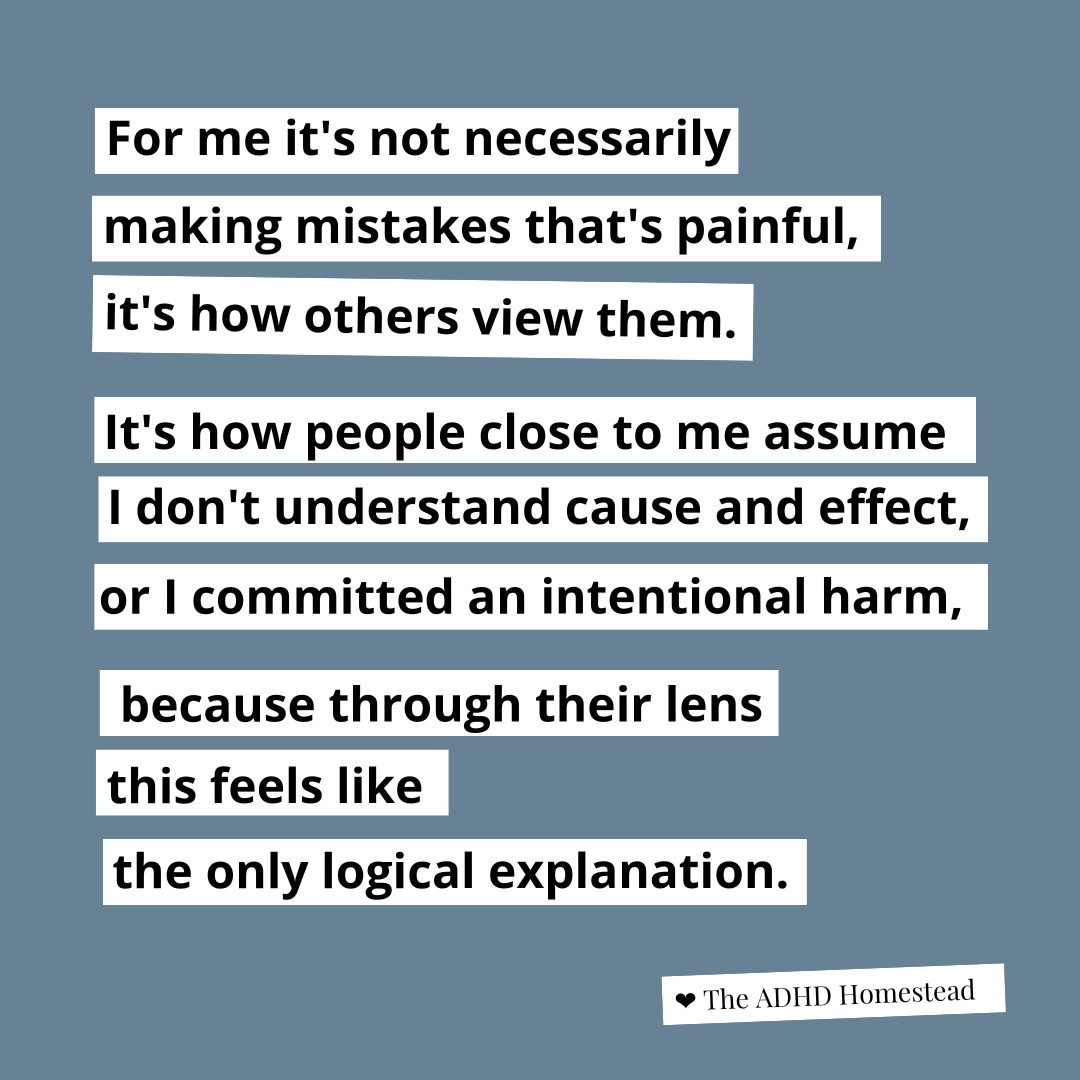
No one will fault you for wearing a knee brace, or favoring an injured limb. But because the brain controls our thoughts and behavior, we assume everything it does is an accurate reflection of intent. It’s not that simple.
Of course, people with ADHD absolutely do make bad choices. We should take responsibility for those choices. ADHD is not an excuse for irresponsible or inconsiderate behavior, even if it may offer a partial explanation.
What we all need to realize is, dopamine — or the lack thereof — can make a person look like a total jackwagon. We aren’t doing this on purpose. Continuous screw-ups from a person with ADHD probably aren’t indicative of an inborn character flaw. They’re a sign of poorly-managed ADHD.
While poorly-managed ADHD is no picnic, it’s a problem we can solve. And it’s a heck of a lot better than living under a pile of labels like “lazy,” “irresponsible,” “inconsiderate,” and “careless.”
This post was edited to include audio narration and a new graphic on August 31, 2022.
Hey there! Are you enjoying The ADHD Homestead?
Here's the thing: I don't like ads. I don't want to sell your attention to an advertising service run by the world's biggest data mining company. I also value my integrity and my readers' trust above all, which means I accept very few sponsorships/partnerships.
So I'm asking for your support directly. For the cost of one cup of coffee, you can help keep this site unbiased and ad-free.
Below you will find two buttons. The first lets you join our crew of Patreon pals and pledge monthly support for my work. Patrons also have access to my Audioblogs podcast. The second takes you to a simple donation page to pledge one-time or recurring support for The ADHD Homestead, no frills, no strings. Do whichever feels best for you!

So, I have a son with ADHD, he’s 18, been off meds since 15 as he says they “dull him down”. Refuses to take them. Has insomnia and is basically doing zilch with his life… Suggestions?
My thoughts are he isnt on the right meds or the right dosage. Its not easy to find it but when he does. What a positive difference it will make for him. Im a 52 yr old mom. Who has been on meds and off meds. Based on my own personal experience. The right ones can bring a balance to my life and cause me to want to “do” the daily tasks of life and be a productive part of life. I really hope this may be of help and he will reconsider.
Thanks, Karen. I think the meds were great for when he was younger (& he loved them) but the addition of hormones during adolescence was the kicker. Unfortunately, in Australia, once 18 he has to move from the public system and his lovely paediatrician to an unknown (private) psychiatrist. First appointment in the vicinity of $700. No psych is obliged to take him and since he self-medicated and overdosed twice (& was in ICU in comas both times to protect him), he will probably not be prescribed any type of meds along these lines for quite some years. It is all heart-breaking. They know that those who aren’t medicated are more likely to self-medicate, but then if they do self-medicate, they deny them access to what they actually need. Also ADHDers are over represented in jails, as homeless &/or having mental health issues because they simply don’t fit into the neurotypical culture and they need more support, not less. They need access to public health system for their meds, not things put in the way.
Sandra, that is heartbreaking. What a thing to have to go through. I completely agree, it has been shown that the correct ADHD meds, at the correct dosage, can significantly decrease risk of addiction and substance abuse. The fact that any substance abuse problem often results in denial of access to legitimate pharmaceutical treatment is just backward.
I don’t give too much specific guidance along these lines here because a.) I don’t have a medical degree and b.) everyone’s different, but I can say with confidence that ADHD meds shouldn’t make you feel “dulled down” or otherwise uncomfortable/not yourself.
However…many, many prescribers don’t follow the rule of starting low (as in, so low you may not notice anything at all) and increasing the dosage slowly, and doing this test with the *name brand drug first*. Generics are all over the place, quality-wise, and often do not offer you a representative experience of what the drug is supposed to do.
Not only that, many docs start with Adderall, which has a higher rate of negative side effects — and bad, mood-related ones, too. There really is no reason to try it first (in fact, some recommend trying it *last*), and yet many do, and it gives the patient a negative impression of ADHD meds in general.
Most people will find one class of meds (Vyvanse/Adderall/etc. vs. Ritalin/Concerta/etc.) will work better than the other. My husband prefers the AMP class (Vyvanse) but those suck for me. I have been happy with Concerta. But it may take a while to learn this, and you need a prescriber who gets it, and will work with you to find the correct medication and dosage.
Best of luck in all this. If you really cannot find a doc who’s willing to prescribe stimulants, some have found relief with a non-stim like Strattera. According to my doc, it’s a minority, and that’s why Strattera never really took off, but “for the people it helps…it really helps.”
HI Jaclyn, it has been heartbreaking. As I said, he loved his meds for a number of years, and was started low by his paediatrician and built up. Obviously the dosage changed a lot as he was 10 when he started and now he’s almost an adult! He has tried Ritalin (terrible for him) and Dexys (brilliant for 3-4 years, but then this “dulled down” feeling at 13/14…). I asked his paediatrician to try him on Vyanase when he was just 17 but she had never prescribed and felt that he was too close to him swapping doctors and didn’t want to do it. I’ll look up Strattera. At least he is seeing a clinical psychologist who is an ADHD specialist, but naturally he can’t prescribe. GPs in Australia can’t prescribe either, only co-prescribe if nominated by the prescriber (it’s a controlled drug here and all goes through the Health Dept)
I should also add my oldest son also has ADHD. I have seen him struggle with life all because of on meds, off meds and lack of knowing ADHD even exists. Its really hard for a parent to see. I really hope.your son will reconsider
Oh god thank you for explaining the dopamine deficiency situation. Nobody every told me this about my ADHD, so I’ve never understood why I can’t get very excited about goals that are in the future. I get it now and will start breaking tasks down into chunks that will let me have more “instant gratification” moment. I thought something was really wrong with me because I can’t get excited about upcoming events, birthdays, goals, deadlines, accomplishments… it’s so life changing to understand the neurochemical reason for this.
Glad this helped you! I find it so valuable to know what’s happening in my brain so I can work around it instead of just getting angry with myself.
Thanks for this. My 12 year old has ADHD and this really helped me understand him so much better!
I’m so glad! If my journals from that time are to be believed, 12 can be a tough age 🙃