Organizing my daily life: it feels like both the starting point and the impossible dream with adult ADHD. It’s also a basic expectation of adulthood.
Most ADHD’ers know we need an organizational system, but feel like nothing works. We struggle to find answers to the all-important question, “but how?”
A naturally organized person with a manageable schedule might answer, “you just do it.” Adults with ADHD rarely “just do” anything.
Today, I’ll share a simple, low-tech, flexible way to stay organized. It’s called Bullet Journal. First I’ll provide a look inside my notebook, then I’d love to answer questions in the comments. Personal organizing has been a pet project of mine for many years. If you want to talk about the nitty gritty, I’m your girl.
What is Bullet Journal?
Bullet Journal isn’t an app or a product. It’s an idea, best explained in this short, engaging little video:
I use apps to stay organized, but I appreciate a tactile element. Screens can feel too abstract. I’ve carried a notebook everywhere since the seventh grade. I’ve dallied with day planners, but fallen away from them since the advent of smart phones. Nowadays, I use my notebook for everything: Grocery lists. jotting down ideas, drafts, or outlines for writing projects. Taking notes at meetings. On-the-fly to-do lists. Goal-setting exercises. Everything imaginable.
Bullet Journal helps me organize those elements and keep me from losing track of what I write down. Because I have ADHD and a very poor memory, I write nearly everything down.
Adults with ADHD are individuals — Bullet Journal is flexible.
I love Bullet Journaling’s infinite flexibility. I chose the size, feel, and contents of my notebook to make it something that works for me. This is especially important for adults with ADHD. If a system or tool isn’t easy, comfortable, and even fun to use, it won’t last long.
I keep my Bullet Journal in Moleskine’s extra-large ruled notebook. In the spirit of Marie Kondo’s KonMari method, I use postcards — mostly collected from art shows — to make the notebooks special and joyful to use.

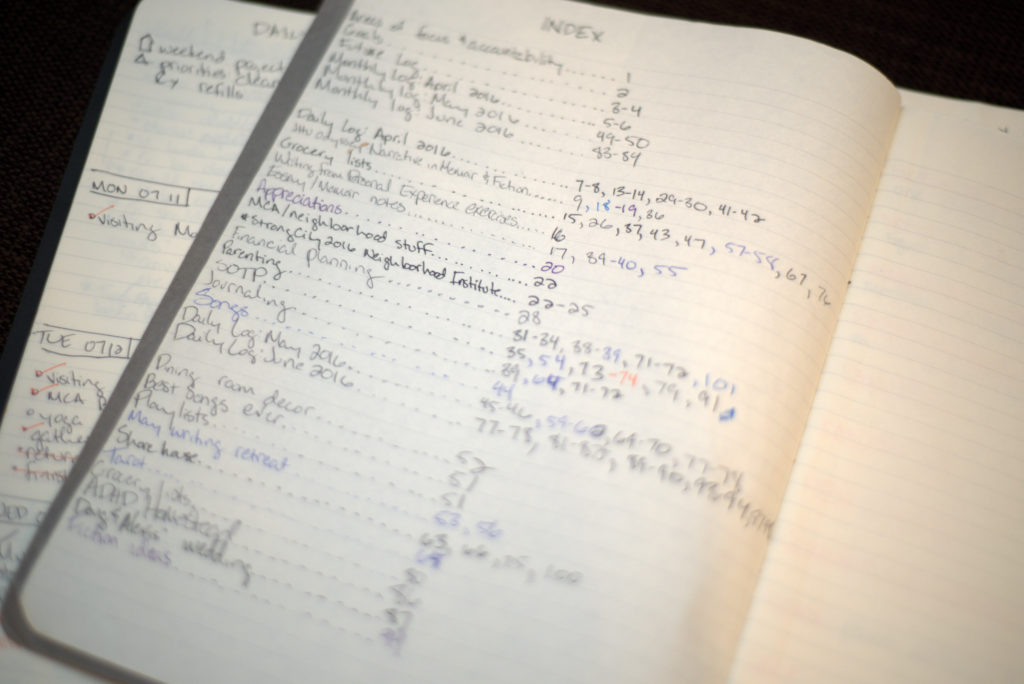
I always add an entry to the index or add a page number to an existing entry before adding the content. Otherwise, I can get distracted and forget to update the index.
Bullet Journal’s flexibility extends inside the notebook, too, allowing me to integrate new concepts while ditching what doesn’t work. For example, I never look at my Future Log. I’d love to examine my six-month view more often, but I’ve come to accept — with compassion and objectivity, of course — that it’s not going to happen with this life and this brain. My next Bullet Journal won’t have a Future Log. Instead, I may beef up the Monthly Log, which I include in my weekly review.
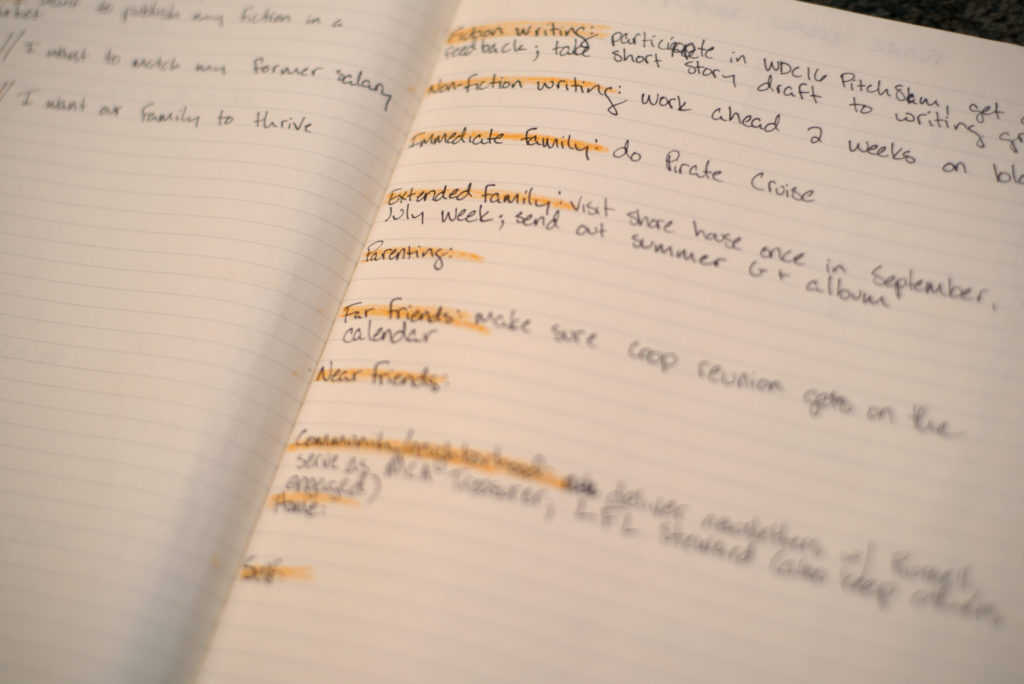
I also added pages to the front of my Bullet Journal to remind me of my many responsibilities and spheres of influence. Stephen Covey calls these “roles and goals” in his book, 7 Habits of Highly Effective People. In Getting Things Done, David Allen refers to them as “areas of focus and accountabilities.” Either way, I maintain a space in my notebook to reflect on my roles in the world and my goals for each. I skim over these pages at my weekly review.
Using my Daily Log with Google Calendar
I use Google Calendar to track all events, meetings, and time-sensitive tasks. I copy entries from my Google Calendar to the Daily Log as part of my weekly review. I never add directly to the Daily Log, always Google Calendar. It’s critical for me to respect my primary resource/repository for a specific kind of information.
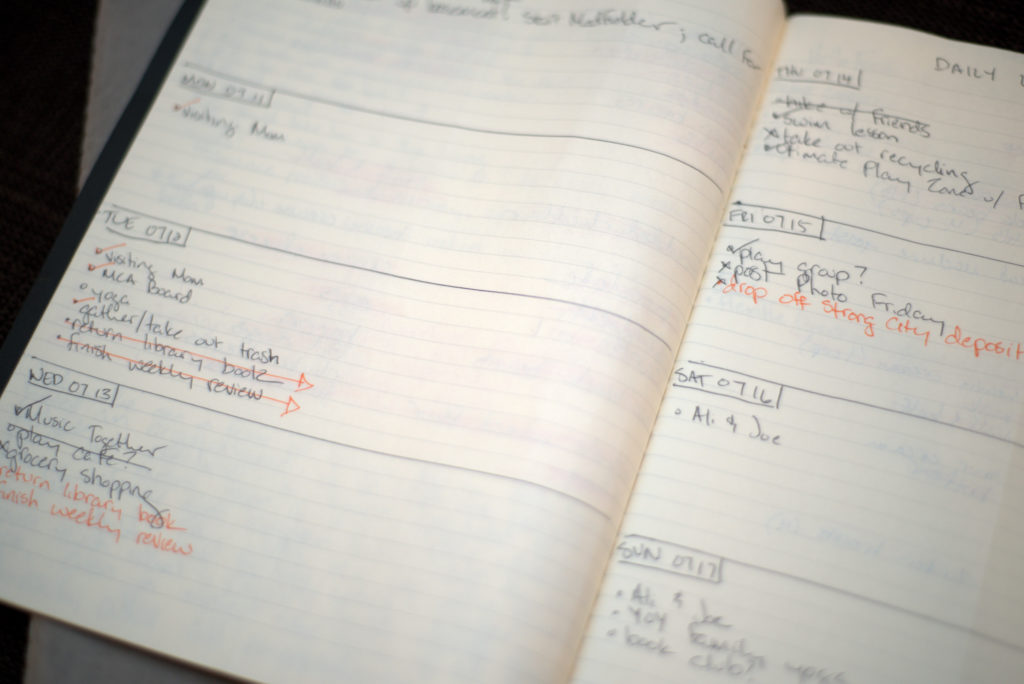
You might be wondering why I recopy rather than print my calendar and paste it into the notebook (or look at the widget on my phone’s home screen). The tactile experience of writing helps me encode/process information. I also never take notes on a laptop or tablet, only with pen and paper, because I remember conversations more clearly that way.
Taking time to write down my schedule, deadlines, and obligations for the week helps me think it through. I wouldn’t get this from skimming my Google Calendar.
Notice the lack of to-do items under each day? My to-do list is long, and nowhere near my Daily Log. I use David Allen’s Getting Things Done system, which discourages “daily to-do lists.” I only tie a task to a day if it really must happen then: in other words, it becomes irrelevant or incurs a late fee.
Let’s chat in the comments.
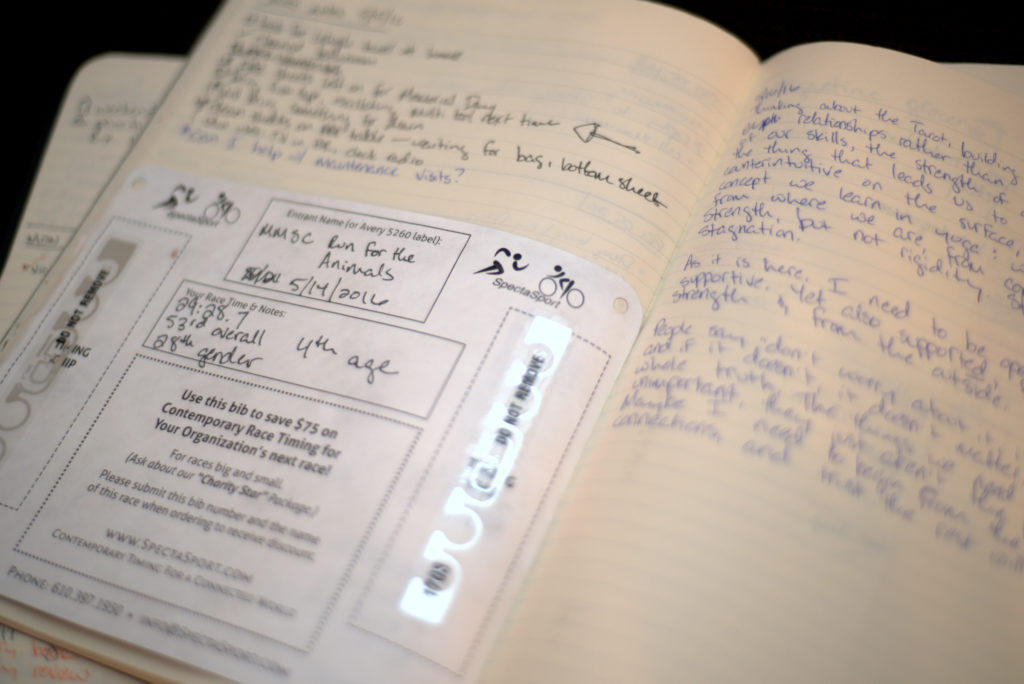
When I say I use my notebook for everything, I mean everything, from grocery lists to a race bib from a recent 5k run. The Daily Log and Monthly Log pages keep everything in a rough chronological order, and the index lets me return and add to previous entries.
Have you tried something like this before? How did it go? Are you hesitant to try it because you think it won’t work? Please share your questions and experiences in the comments. I’d love to chat!
Hey there! Are you enjoying The ADHD Homestead?
Here's the thing: I don't like ads. I don't want to sell your attention to an advertising service run by the world's biggest data mining company. I also value my integrity and my readers' trust above all, which means I accept very few sponsorships/partnerships.
So I'm asking for your support directly. For the cost of one cup of coffee, you can help keep this site unbiased and ad-free.
Below you will find two buttons. The first lets you join our crew of Patreon pals and pledge monthly support for my work. Patrons also have access to my Audioblogs podcast. The second takes you to a simple donation page to pledge one-time or recurring support for The ADHD Homestead, no frills, no strings. Do whichever feels best for you!

You are an inspiration, J!
Love this! I have been using the GTD method (albeit inconsistently) for the last little while and it’s been the most effective thing so far. I also dabbled in Bullet Journaling (looking to jump back on that train because boy does my life really get off the rails without a straight-forward system). I know it’s different for everyone, but would you be willing to share how you use these two systems together? What goes in the BuJo? How do you track things and work the two systems together? Thanks!
Hi Lyndsey! My Bullet Journal system has only a few overlaps with GTD. It’s mostly for note-taking, writing, etc.
The except is my monthly and daily log pages. Both play a part in my GTD weekly review.
I store task lists in Toodledo because it’s the best method I’ve found for organizing projects and next actions. I don’t keep any of my general to-do lists in Bullet Journal. I make exceptions to that rule when I’m doing something very episodic, like writing a to-do list for the morning before we leave on vacation.
Per GTD, I keep any time-bound next actions in my calendar, and I use Google Calendar for that. During my weekly review, I copy these from my Google Calendar into my daily log. This physical activity/process helps get my upcoming need-to-do tasks embedded in my brain. I also try to lay my notebook at my place at the dining room table, open to my daily log spread, before I go to bed at night. This way I see it even if I don’t get around to looking at my phone until after breakfast. I like that because I’m sensitive to the power of screens in our lives and like to be able to ignore my phone during family time whenever possible.
I glance over my monthly log pages every week during my weekly review or, if I’m coming up on a new month, I create those pages. I have a checklist of weekly review tasks in Google Keep so I remember to do my monthly and daily log pages.
The most important thing with GTD, for me, has always been remaining faithful to your primary container. For projects/next actions, that’s Toodledo. Everything I’m working on goes in there. When I take notes for a project, it goes in my Bullet Journal so it’s indexed and easy to find. GTD recommends including this kind of thing in your alphabetical filing system, but I prefer to keep it in my notebook and that works for me because of Bullet Journal’s handy index. I try to avoid taking notes on looseleaf in favor of my notebook.
Likewise, Google Calendar has the final say over my daily log. I transfer things from GC to my Bullet Journal, never vice versa. Keeping strict rules like this allows me to trust each system to fill its intended purpose.
I hope that makes sense! Let me know if I left anything unanswered!
Hi Jaclyn!
Thank you so much for taking the time write out such a thorough answer. This is really helpful to me. I hadn’t heard of Toodledo and it seems like it would work really well with GTD…I’m testing it out now. The act of laying your notebook at your place is nothing short of brilliant. Being a visual person, this would be so helpful for me. I also may or may not misplace my phone on a regular basis…
I could never get the alphabetical filing system to work for me (though I do use a hard copy “tickler” system) so the way you use your Bullet Journal for this is something I’d like to try.
Thank you again, so very much! From someone struggling to get my daily life organized (and pursuing an ADHD assessment – we’ll see where that goes), this means more than you know.
Wishing you a beautiful day,
Lyndsey
P.S. If you have a referral code for Toodledo, let me know and I’ll be sure to use it if/when I grab a subscription
So glad I could help! My Toodledo link is: http://www.toodledo.com/index.php?ref=td50ec69dd058f7
I’m planning on posting a video tour of my Toodledo system in October or November, so keep an eye out for that!
Incidentally, I do use an alphabetical filing system for some things, but not for my notes. I store all kinds of things in hanging files: the negative tray for my scanner, those little postcards you fill out to hold your mail delivery for vacation, crochet pattern books I found in my great-grandmother’s things…all of this feels great for storage in the alphabetical system, and I lose far fewer things than I used to before I started this system.
If I take notes at a meeting, or do some longhand writing for a fiction project, or organize my thoughts with pen and paper, this needs to happen in my notebook. Bullet Journal’s silly-simple index has been a lifesaver in terms of allowing me to *find* things after I write them down 😛
Thanks! I’ve used your link (but haven’ t purchased a subscription yet…but I’d really like to. Need to wait for it to be approved by the budget ;)). I’ve been using the free version and it just works. So much better than
any of the other million apps I feel like I’ve tried, so from the bottom
of my heart, thank you.
I have subscribed and can’t wait to see your video tour later on. Those do sound like good uses for the alphabetical storage system! Honestly (and this feels ridiculous), I have never been organized to put those types of things where I could find them. It’s a (constant) work-in-progress. First up – get daily life manageable and then perhaps find some help in tackling the rest of everything.
Finding things is always the hard part! And you’re right, the bullet journal’s index is fantastic for that. Going to jump back into it this week! Or at least, that’s the intent.
Thank you Jaclyn! I really appreciate your replies and answers. I feel a glimmer of hope somewhere in the distance.
What made you decide to use a Bullet Journal? Have you found any evidence-based research that has been conducted about how the bullet journal might aid in helping people live more intentionally, increase productivity, and/or relieve stress?
Not sure how much research is being done on Bullet Journaling in particular, haha.
But someone else just asked me why I use Bullet Journal as opposed to something else, and how/why I make time for it.
I have a terrible memory and can’t keep anything in my head for long. It’s not about making myself use this system. Since I was a kid, I’ve used list-making and writing things down as a form of self-soothing. I feel a need to write out my daily log for the week every Sunday night or Monday morning. If I don’t, I experience pretty bad anxiety. I feel lost and intensely cranky at best.
As far as Bullet Journal goes, I’ve carried a notebook ever since I watched the movie Harriet the Spy at age 13. I’m a writer. I’ve tried to use a planner in conjunction with my regular notebook, and it hasn’t stuck. Bullet Journal allowed me to condense everything into one notebook and index/organize that info so I could find it later. It’s been a godsend.
In other words, it’s what works for me! That’s what this blog is all about: sharing what works for me and answering questions, in hopes of helping someone else along the way 🙂
I Love the bullet journal. I Have been using it for about a year at my current job in the social work field. How do you think keeping a billet journal has effected your stress level?
Hi J – I told my Adult ADHD group, in Palo Alto, about this post last night. Of course, most of them looked it up on the spot. 🙂 But now I’ll share to my mailing list.
Why thank you! I hope they find it useful!
Omg this is wonderful thank you