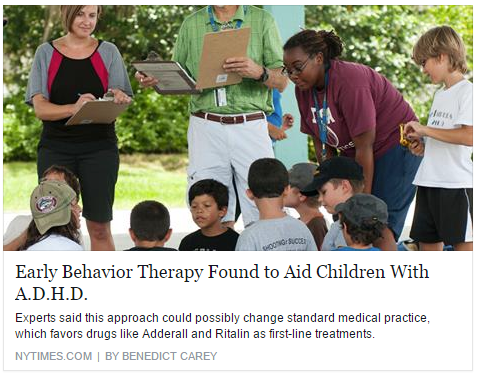
When I see ADHD trending on social media, I perk up my ears. Today, it’s the release of new study results supporting behavior therapy as a first-line treatment for children with ADHD.
This raises important questions. It also fans the flames of controversy among those opposed to medicating ADHD in children.
I see this study as an incomplete answer to a complex question: what’s the best course of treatment for childhood ADHD?
Interpreting results: why start with behavior therapy?
Starting with behavior-based interventions may emphasize the importance of teaching coping mechanisms. I’ve long said that neither medication nor behavior therapy can do it alone. Medication balances our brain chemistry, making coping mechanisms easier — or possible — to implement.
Starting meds with no therapy or parent training may set the wrong expectation: that meds can do all the work. Starting with behavior therapy, then adding medication, allows families to compare and contrast the difference.
Taking an example from my personal life, I talk a lot about David Allen’s Getting Things Done. I swear by it. Did you know I’ve only been able to maintain it while taking medication? Without it, I can’t keep up.
However, medication in no way alleviates my need for such a rigid system.
We should teach children this symbiosis from the beginning. Offering medication alone is like offering eyeglasses to a near-sighted child and expecting those glasses to teach him to read.
Why I’m skeptical about behavior therapy’s long-term benefits
I’m not jumping on the behavior modification bandwagon just yet. I think we need a longitudinal study to evaluate the effects well into adulthood, when we’re expected to create our own structure and motivation.
Behavior modification therapies, as explained in Stephen P. Hinshaw and Katherine Ellison’s book ADHD: What Everyone Needs to Know, require “clear expectations and explicit, frequent rewards, as well as occasional, nonemotional discipline.” Think sticker charts to help kids earn a reward for improving target behaviors.
My own parents promised me a TV in my bedroom if I could produce a few second-grade report cards with no failing grades in the ‘behavior’ column. My burning desire for that television supported the herculean effort required to stay out of trouble. I got the TV.
Looking at this one academic year, anyone could conclude that behavior-based interventions improved my most problematic symptoms. However, as Hinshaw and Ellison point out in their book, “the difficulty for children is to maintain their progress once they’re out of the tightly managed environment.”
My third-grade reports reflect missed homework, inconsistent effort, and frequent run-ins with other students.
Should we expect parents to maintain a highly structured environment indefinitely? What happens when children grow too old for sticker charts? What happens when parents aren’t there to light a fire under a kid’s butt?
I’ll tell you what happened to me: my life spiraled out of control. My desk at work was covered 8-12 inches deep all around with papers, and I frequently lost important documents. I fought with my husband all the time. I suffered wild mood swings. Bills went unpaid. It took so long for me to take checks to the bank, they often expired before I could deposit them. My house was a mess. The list goes on.
Does behavior therapy prepare kids with ADHD for the future?
I’m not surprised to see a study confirming the effectiveness of behavior therapies — that is, rigid systems of externalized rewards and consequences — in the short term. We’re talking months, or even a few years.
I worry that we’re failing to teach kids true independence and long-term coping mechanisms. As Vicki Hoefle explains so effectively in her lovely book Duct Tape Parenting, parents should measure success not by how kids behave right now, but whether they’re ready to fledge at age 18. Childhood gives kids an opportunity to learn crucial skills in a safe, supportive environment.
Creating a system of made-up consequences robs them — and us — of that opportunity. Sure, I was able to control my outbursts to earn that TV. What did I learn about myself during that time? What tools did I put in my mental toolbox, to be carried into adulthood?
Yes, this study addresses an important issue. I hope it reinforces the symbiotic relationship between medication and other interventions. I hope fewer parents, teachers, and doctors see medication as a way to make ADHD an open-and-shut case.
Parents need to ask: what’s our goal here? Do we want the best of both worlds? To refuse medication for our kids while putting a stop to failing grades and uncomfortable parent-teacher conferences?
Or do we want to deepen our relationship with our kids while teaching them how to succeed as adults?
For that, we need to examine the effectiveness of behavior therapy once the subjects reach age 25, 30, and 35.
What do you think we’d find? I’m curious about others’ reactions. Did you read about this study? Have you had any first-hand experience with behavior modification? Please chime in with a comment below!
Hey there! Are you enjoying The ADHD Homestead?
Here's the thing: I don't like ads. I don't want to sell your attention to an advertising service run by the world's biggest data mining company. I also value my integrity and my readers' trust above all, which means I accept very few sponsorships/partnerships.
So I'm asking for your support directly. For the cost of one cup of coffee, you can help keep this site unbiased and ad-free.
Below you will find two buttons. The first lets you join our crew of Patreon pals and pledge monthly support for my work. Patrons also have access to my Audioblogs podcast. The second takes you to a simple donation page to pledge one-time or recurring support for The ADHD Homestead, no frills, no strings. Do whichever feels best for you!

Wow, you nailed it, Jaclyn.
Some of the most “lost” people with ADHD I know are those who were diagnosed as children and schooled in highly structured, “accommodating” environments. School and home.
No one was more surprised than their parents when the kids had “failure to launch.”
No one was angrier than those kids, that the world was not accommodating them as their school did.
This study is so predictable. Bill Pelham is the “renegade” MTA researcher. He has a Summer Camp for ADHD Kids franchise. He, like many psychologists, is hell bent on proving that “their” methods (talk therapy, behavioral strategies, etc.) are better than medication. It’s their professional bias.
One glaring problem with that study. They used GENERIC Ritalin. Why? Why use a type of medication known to be inferior to the brand? There couldn’t be an agenda there, could there?
And, what was it…3/4 of the children who suffered through a year of “behavioral” strategies needed medication. What about that year? What kind of developmental milestones were lost? What kind of erosion to self-esteem (even self-concept) took place? How many arguments and power struggle at home?
Good grief!
These kids obviously need behavioral strategies as well as medication, together. More importantly, they need parents who can help work with the MD to “dial in” the best results from medication, continue the behavioral strategies, etc.
And, guess what? Many of these parents have ADHD? Are they screened? No, not as a rule. Diagnosticians are often afraid to “go there.” And so the child becomes the identified patient, while dealing with ADHD-related chaos and disconnection from one or both parents.
THAT is the elephant in the room that none of these studies even touch upon. And it’s an elephant I’ve been talking about for 16 years.
Thanks for this post!
Gina
Oh, Gina, thank you for mentioning the generic Ritalin. By the time I got done my rant about the other stuff, I totally forgot to mention it in the final version of this post!
But yes, from personal experience, the popular generics are way different than the name-brand drug. Generic Concerta may have caught the attention of the FDA for too much variation while still claiming equivalency, but I believe the FDA even allows significant variations (up to 20%) so I can’t imagine what is going on in these drugs.
I also can’t imagine, given the acknowledged $&%show that is generic stimulant meds, why anyone would choose to use them in a study.
Like I said in my review of Penny Williams’ Insider’s Guide to ADHD, someone needs to start looking harder at the parents, or even today’s 25-year-olds who have, indeed, failed to launch. We can learn so much.
The Generic Concerta flap was pretty complex. I guess you saw my posts on it. I led the effort to get them downgraded.
Yes, bioequivalence for generics allows for a 20 percent UP OR DOWN variation. Plus, there is the issue of colorants and binders, which can affect many people adversely. Especially, it seems, “hypersensitive” people with ADHD.
My post on this from 2009:
http://adhdrollercoaster.org/tools-and-strategies/consumer-reports-on-vacuum-cleaners-maybe-on-adhd-medications-definitely-not/
As I wrote there:
“In the U.S., the FDA requires the bioequivalence of the generic product to be between 80% and 125% of that of the original product.”
So, it’s not just 20 percent, but a much larger window of variation.
I began my work after volunteering locally, and seeing that some parents kept asking the same questions, month after month, wondering why they couldn’t get traction with their child’s ADHD-related challenges. Guess why? 🙂
That has been my emphasis from the start, around 2001, when few others were even talking about Adult ADHD.
Yep, I read it, and that’s what inspired me to demand name-brand drugs for myself. Made a difference.
I guess my thinking is just this: it took a serious effort on your part to get the generic Concerta downgraded. It’s not like the FDA was proactive.
This is on top of standards that already seem kind of lax — 20% is a big deal, especially when ADHD medication dosages often need such precise tweaking to get it right.
And the generic Ritalin I switched away from was made by the same manufacturer. Knowing my own experience, I cringe to think of it being used in a study on medication efficacy.
Yes, well, I guess that shows the importance of an active citizenry. 🙂
The generics have been very helpful for many people who cannot afford brand and whose insurance companies don’t offer them. And some of them work okay. You just have to take a different dosage than with the brand. Some medications don’t require as precise a “therapeutic window” as do the stimulants.
But when pharmacies change the supply, from one manufacturer to another, you don’t know what you’re getting month to month.
As regards this study, however, I find it downright dishonest and even “loading the deck” against medication.
The NYTimes Benedict Carey (who once laughed at my suggestion that children could have bipolar, because after all they weren’t having sex or using credit cards…) is hardly the journalist to poke holes in this study. And comments weren’t enabled, as far as I could see.
Shared on Twitter.
Interesting – even moreso after reading Gina’s comment. I did not know there was a camp for ADHD kids. Oy. I am so so tired of these “guru” marketers. anyway – my brother and I were talking recently about our childhood and ADHD. We were both given the medications without much in the way of therapy. We met with a therapist for the diagnosis but once we got the rx we didn’t go back more than once per year. I definitely think my mom was looking for a way to make her life easier. I think for my son I want to find the right balance of both, if that is possible.
Wow. That’s terrible, especially for kids, whose bodies, brains, and metabolisms can change so quickly. My doctor insists on speaking to me in person at least once every three months to check in on how I’m doing.
Medication has helped me so much, but it hasn’t done everything. Perhaps it does make my behavior toward others more tolerable, which is probably something your mom noticed, too.
But the real benefit to me has been the capacity to set up some coping systems to get my life in order. That’s not something meds do for me, it’s something they give me the ability to learn to do.
Without that piece of the puzzle, I can understand why people feel negatively toward meds, or don’t have as much success with them as they would like.
My brother was on Ritalin from the age of 4 until about age 21. He resents it to this day. He has a lot more anger about the medications than I do. He really feels like they affected him in some negative way but he cannot explain it well. He feels like it helped the people around him more than it helped him. if that makes sense?
It does make sense. Medication should be a tool to make it easier for us to do the things we want and need to do in our lives. If someone — child or adult — is pressured to take medication and feels it’s for others’ benefit more than their own, that’s totally counterproductive.